

What is the Present Simple Affirmative?
We use the Present Simple to talk about things that happen regularly. These are your habits or daily routines.
- I wake up at 7 AM every day. (A daily routine)
- She drinks coffee in the morning. (A habit)
We also use it for general facts or truths that are always true.
- The sun rises in the east. (A general fact)
- Cats like milk. (A general truth)
🎓 Englisch lernen mit der Blended-Methode
Kleingruppen · KI-Tutor rund um die Uhr · Vorbereitung auf die Cambridge-Prüfungen
Pläne von $39 $79 pro Monat
How do we form the Present Simple?
To make a positive sentence in the Present Simple, we use the subject and a verb.
- For subjects I, You, We, They, use the base form of the verb. This is the verb without to. For example, work, eat, live.
- For subjects He, She, It, add -s oder -es to the end of the verb. For example, works, eats, lives.
What are the spelling rules for -s and -es?
Most verbs just add -s für He, She, It:
- walk → walks
- play → plays
If a verb ends in -ss, -sh, -ch, -x, oder -o, add -es:
- pass → passes
- wash → washes
- watch → watches
- fix → fixes
- go → goes
If a verb ends in a consonant + -y, change the -y to -ies:
- study → studies
- fly → flies
Das Verb have is special. It changes to has für He, She, It:
- I have a car.
- She has a car.
| Betreff | Verb (Example: to eat) |
|---|---|
| I | eat |
| You | eat |
| He | eats |
| She | eats |
| It | eats |
| We | eat |
| They | eat |
Beispiele
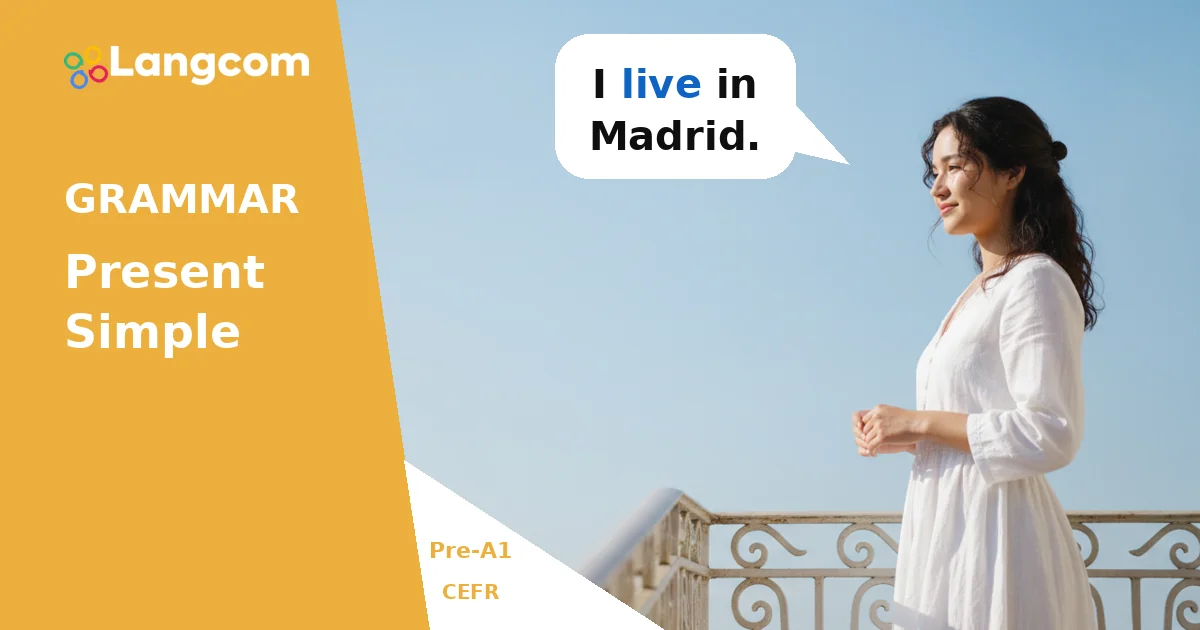
- I live in Madrid.
- You speak English well.
- He works at Langcom.
- She watches TV every night.
- It rains a lot in winter.
- We study English online.
- They go to the park on Saturdays.
- My brother plays football.
- My sister studies hard.
Übung
💬 Benötigen Sie eine individuelle Beratung?
Als autorisiertes Cambridge-Vorbereitungszentrum können wir Ihnen helfen, den richtigen Kurs und die passende Zertifizierung zu finden. Chatten Sie noch heute mit unseren Beratern.
Chatten Sie mit einem Berater auf WhatsAppHäufige Fehler bei Spanischsprechern
A common mistake for Spanish speakers is forgetting the -s oder -es ending for He, She, It. In Spanish, verbs change for every person, but not always with a simple -s like in English.
- Incorrect: He like pizza.
- Correct: He likes pizza.
- Incorrect: She go to school.
- Correct: She goes to school.
Remember this small change is very important in English!
Häufig gestellte Fragen
When do I use the Present Simple affirmative?
You use it for actions you do every day or often (habits, routines), and for things that are always true (facts, general truths). For example, I drink water.
What is the main difference between ‘I work’ and ‘He works’?
The main difference is the -s ending. For subjects I, You, We, They, the verb stays in its base form (e.g., work). For He, She, It, you add -s oder -es (e.g., works).
Is the verb ‘to be’ different in the Present Simple?
Yes, the verb to be is irregular and has special forms: I am, You are, He/She/It is, We are, They are. It does not follow the -s rule for He/She/It.

0 Kommentare