

What is the Present Simple Affirmative?
We use the Present Simple to talk about things that happen regularly. These are your habits or daily routines.
- I wake up at 7 AM every day. (A daily routine)
- She drinks coffee in the morning. (A habit)
We also use it for general facts or truths that are always true.
- The sun rises in the east. (A general fact)
- Cats like milk. (A general truth)
🎓 Impara l'inglese con il metodo misto
Piccoli gruppi · Tutor IA disponibile 24 ore su 24, 7 giorni su 7 · Preparazione agli esami di Cambridge
Piani da $39 $79 al mese
How do we form the Present Simple?
To make a positive sentence in the Present Simple, we use the subject and a verb.
- For subjects I, You, We, They, use the base form of the verb. This is the verb without to. For example, work, eat, live.
- For subjects He, She, It, add -s oppure -es to the end of the verb. For example, works, eats, lives.
What are the spelling rules for -s and -es?
Most verbs just add -s for He, She, It:
- walk → walks
- play → plays
If a verb ends in -ss, -sh, -ch, -x, oppure -o, add -es:
- pass → passes
- wash → washes
- watch → watches
- fix → fixes
- go → goes
If a verb ends in a consonant + -y, change the -y to -ies:
- study → studies
- fly → flies
The verb have is special. It changes to has for He, She, It:
- I have a car.
- She has a car.
| Subject | Verb (Example: to eat) |
|---|---|
| I | eat |
| You | eat |
| He | eats |
| She | eats |
| It | eats |
| We | eat |
| They | eat |
Esempi
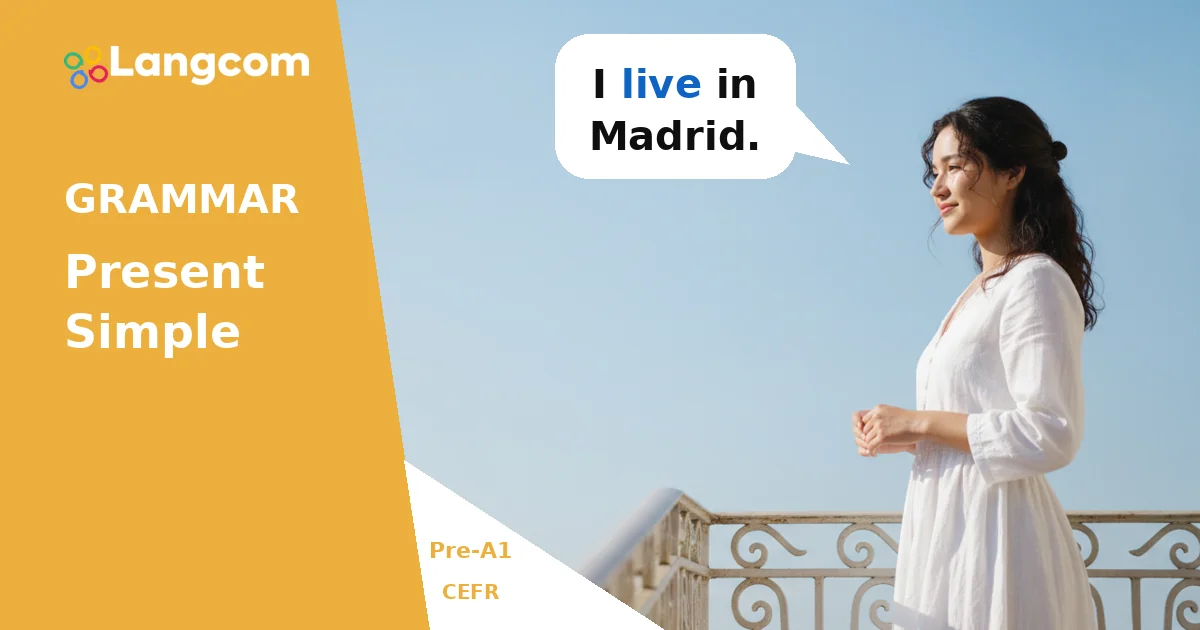
- I live in Madrid.
- You speak English well.
- He works at Langcom.
- She watches TV every night.
- It rains a lot in winter.
- We study English online.
- They go to the park on Saturdays.
- My brother plays football.
- My sister studies hard.
Esercitazione
💬 Hai bisogno di una consulenza personalizzata?
In qualità di Centro autorizzato di preparazione agli esami Cambridge, possiamo aiutarti a scegliere il corso e la certificazione più adatti alle tue esigenze. Contatta oggi stesso i nostri consulenti.
Chatta con un consulente su WhatsAppErrori comuni per chi parla spagnolo
A common mistake for Spanish speakers is forgetting the -s oppure -es ending for He, She, It. In Spanish, verbs change for every person, but not always with a simple -s like in English.
- Errato: He like pizza.
- Corretto: He likes pizza.
- Errato: She go to school.
- Corretto: She goes to school.
Remember this small change is very important in English!
Domande frequenti
When do I use the Present Simple affirmative?
You use it for actions you do every day or often (habits, routines), and for things that are always true (facts, general truths). For example, I drink water.
What is the main difference between ‘I work’ and ‘He works’?
The main difference is the -s ending. For subjects I, You, We, They, the verb stays in its base form (e.g., work). For He, She, It, you add -s oppure -es (ad esempio, works).
Is the verb ‘to be’ different in the Present Simple?
Yes, the verb to be is irregular and has special forms: I am, You are, He/She/It is, We are, They are. It does not follow the -s rule for He/She/It.

0 Commenti