
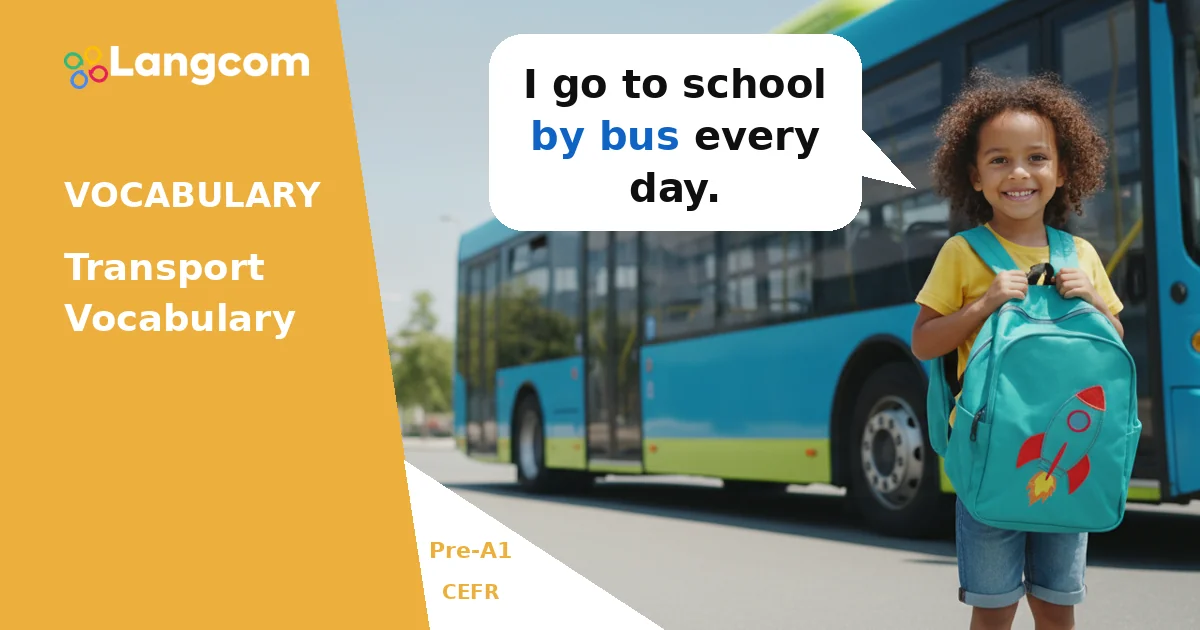

For example, you can say I go to work by bus oder We travel by plane for holidays. Knowing these words like car, bus, train, plane, boat, bike, und motorbike makes your English communication clearer and more effective. Start using them today to describe your journeys!
What are common transport words?
Many words help us talk about how we travel. These are some of the most common and useful words for transport.
- A car is a vehicle with four wheels. Many people use a car to go to work or visit friends.
- A bus is a large vehicle that carries many people. It often follows a specific route in a city.
- A train is a long vehicle that runs on railway tracks. It can carry many people or goods over long distances.
- A plane is a vehicle that flies in the air. People use a plane to travel to different countries.
- A boat is a small vessel that travels on water. You can see boats on rivers, lakes, or the sea.
- A bike (or bicycle) is a vehicle with two wheels. You use your legs to make it move.
- A motorbike is a vehicle with two wheels and an engine. It is faster than a bike.
🎓 Englisch lernen mit der Blended-Methode
Kleingruppen · KI-Tutor rund um die Uhr · Vorbereitung auf die Cambridge-Prüfungen
Pläne von $39 $79 pro Monat
How do we use transport words?
We use different small words (prepositions) with transport words. The most common way to talk about general transport is with by.
- Use by with most transport words: by car, by bus, by train, by plane, by boat, by bike, by motorbike.
- When you walk, you say on foot.
- When you talk about a specific vehicle, you might use take the. For example, take the bus oder take the train.
| English Word | What it is |
|---|---|
| car | A vehicle with four wheels for personal travel. |
| bus | A large vehicle that carries many people on a route. |
| train | A long vehicle that runs on tracks. |
| plane | A vehicle that flies in the sky. |
| boat | A vessel that travels on water. |
| bike | A bicycle; a two-wheeled vehicle you pedal. |
| motorbike | A two-wheeled vehicle with an engine. |
Beispiele
- I go to school by bus every day.
- My family travels by car on weekends.
- They went to the island by boat.
- She likes to ride her bike in the park.
- We will fly to London by plane.
- He has a fast motorbike.
- The train leaves at 7 o’clock.
Übung
💬 Benötigen Sie eine individuelle Beratung?
Als autorisiertes Cambridge-Vorbereitungszentrum können wir Ihnen helfen, den richtigen Kurs und die passende Zertifizierung zu finden. Chatten Sie noch heute mit unseren Beratern.
Chatten Sie mit einem Berater auf WhatsAppHäufige Fehler bei Spanischsprechern
Using ‘in’ instead of ‘by’
Spanish speakers often say in car oder in bus because in Spanish you say ‘en coche’ or ‘en autobús’. However, in English, for general transport, we use by.
- Correct: I travel by car.
- Incorrect: I travel in car.
Remember to use by when you talk about the method of transport.
Häufig gestellte Fragen
What is a ‘car’?
A car is a common vehicle with four wheels used for personal travel on roads. For example, My car is red.
How do I say ‘viajar en autobús’ in English?
You can say travel by bus oder take the bus. Both are correct. For example, I travel by bus to work.
What is the difference between ‘bike’ and ‘motorbike’?
A bike (or bicycle) moves when you pedal with your feet. A motorbike has an engine and moves by itself, like a small car but with two wheels.
Can I use ‘on’ for transport?
Yes, but usually for specific types of transport where you stand or walk inside, like on the bus oder on the train. For general methods, use by.




0 Kommentare