

What Are Abilities?
An ‘ability’ is something you know how to do. It is a skill or a talent.
For example, if you know how to play a sport, that is an ability. If you can speak another language, that is also an ability.
🎓 Изучайте английский по смешанной методике
Небольшие группы · ИИ-репетитор 24/7 · Подготовка к экзаменам Кембриджского университета
Планы от $39 $79 в месяц
How to Talk About Abilities: Using Can
In English, we use the word can to talk about abilities. It means ‘to be able to’ or ‘to know how to’.
- Мы используем can with a base verb (the verb without ‘to’).
- The form of can is the same for all subjects (I, you, he, she, it, we, they).
Look at the structure:
- Subject + can + base verb
Talking About Things You Can’t Do
If you do not have an ability, or if something is not possible, we use can’t. This is the short form of cannot.
- Мы используем can’t with a base verb.
- The form of can’t is the same for all subjects.
Look at the structure:
- Subject + can’t + base verb
Asking About Abilities: Can You…?
To ask someone about their abilities, we put can at the beginning of the question.
Look at the structure:
- Can + subject + base verb?
For short answers, we say:
- Yes, I can.
- No, I can’t.
Common Abilities Vocabulary
Here are some common verbs you can use with can to talk about abilities:
- swim
- cook
- play football
- paint
- sing
- dance
- speak English
- drive
- run
| Verb | What it means |
|---|---|
| swim | Move through water using your body. |
| cook | Prepare food by heating it. |
| play football | Participate in the sport of football. |
| paint | Make pictures with paint. |
| sing | Make musical sounds with your voice. |
| dance | Move your body to music. |
| speak English | Communicate using the English language. |
| drive | Operate a car or other vehicle. |
| run | Move quickly on foot. |
Примеры
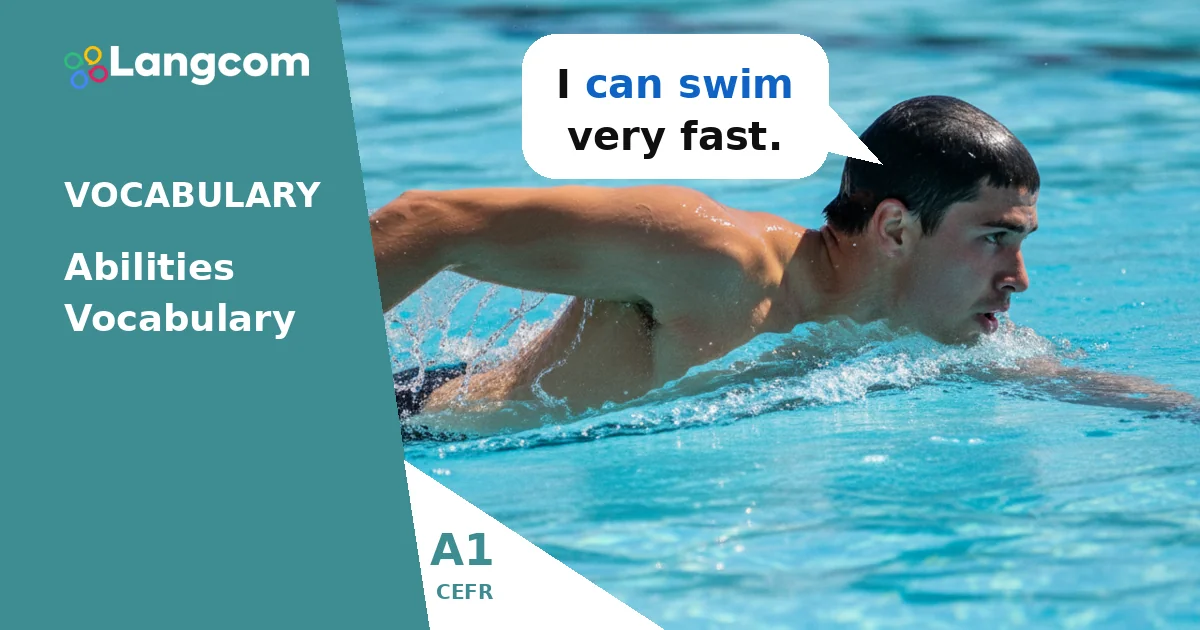
- I can swim very fast.
- She can cook delicious meals.
- He can’t play football very well.
- Can you sing? Yes, I can.
- My brother can dance, but I can’t.
- They can speak English a little.
Практика
💬 Нужна индивидуальная консультация?
Являясь официальным центром подготовки к экзаменам Кембриджского университета, мы поможем вам выбрать подходящий курс и программу сертификации. Свяжитесь с нашими консультантами уже сегодня.
Общайтесь с консультантом в WhatsAppРаспространенные ошибки у носителей испанского языка
Люди, говорящие по-испански, иногда допускают следующие ошибки:
- Using ‘to’ after can: In Spanish, you might say ‘saber hacer’. But in English, we don’t use ‘to’ after can.
- I can to swim. ❌
- I can swim. ✅
- Incorrect negative form: Remember that can’t is the correct negative.
- He no can sing. ❌
- He can’t sing. ✅
Часто задаваемые вопросы
What is an ability in English?
An ability is a skill or something you know how to do, like swim или cook.
How do I say ‘I can’ in English?
You say I can followed by the base form of the verb, for example, I can paint.
What is the difference between can и can’t?
Can means you have the ability to do something. Can’t means you do not have the ability, or it is not possible.
Can I use can for other things?
Да, can can also be used to ask for or give permission, like Can I sit here? But for A1, focus on abilities first!

0 Комментариев