
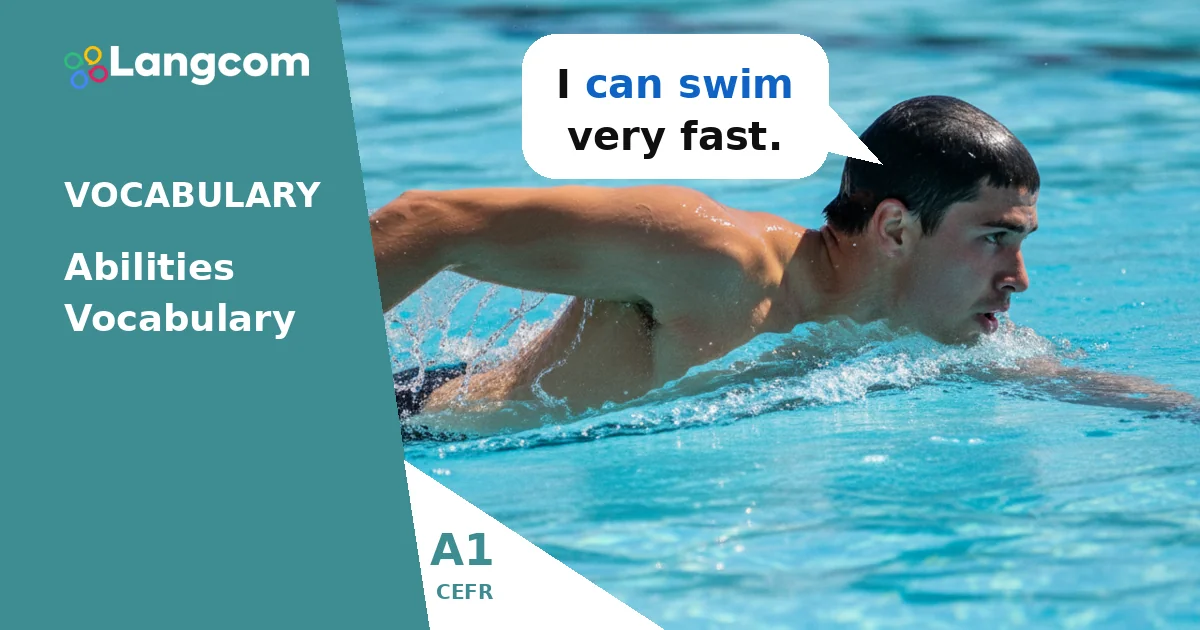

What Are Abilities?
An ‘ability’ is something you know how to do. It is a skill or a talent.
For example, if you know how to play a sport, that is an ability. If you can speak another language, that is also an ability.
🎓 Englisch lernen mit der Blended-Methode
Kleingruppen · KI-Tutor rund um die Uhr · Vorbereitung auf die Cambridge-Prüfungen
Pläne von $39 $79 pro Monat
How to Talk About Abilities: Using Can
In English, we use the word can to talk about abilities. It means ‘to be able to’ or ‘to know how to’.
- Wir verwenden can with a base verb (the verb without ‘to’).
- The form of can is the same for all subjects (I, you, he, she, it, we, they).
Look at the structure:
- Subject + can + base verb
Talking About Things You Can’t Do
If you do not have an ability, or if something is not possible, we use can’t. This is the short form of cannot.
- Wir verwenden can’t with a base verb.
- The form of can’t is the same for all subjects.
Look at the structure:
- Subject + can’t + base verb
Asking About Abilities: Can You…?
To ask someone about their abilities, we put can at the beginning of the question.
Look at the structure:
- Can + subject + base verb?
For short answers, we say:
- Yes, I can.
- No, I can’t.
Common Abilities Vocabulary
Here are some common verbs you can use with can to talk about abilities:
- swim
- cook
- play football
- paint
- sing
- dance
- speak English
- drive
- run
| Verb | What it means |
|---|---|
| swim | Move through water using your body. |
| cook | Prepare food by heating it. |
| play football | Participate in the sport of football. |
| paint | Make pictures with paint. |
| sing | Make musical sounds with your voice. |
| dance | Move your body to music. |
| speak English | Communicate using the English language. |
| drive | Operate a car or other vehicle. |
| run | Move quickly on foot. |
Beispiele
- I can swim very fast.
- She can cook delicious meals.
- He can’t play football very well.
- Can you sing? Yes, I can.
- My brother can dance, but I can’t.
- They can speak English a little.
Übung
💬 Benötigen Sie eine individuelle Beratung?
Als autorisiertes Cambridge-Vorbereitungszentrum können wir Ihnen helfen, den richtigen Kurs und die passende Zertifizierung zu finden. Chatten Sie noch heute mit unseren Beratern.
Chatten Sie mit einem Berater auf WhatsAppHäufige Fehler bei Spanischsprechern
Spanish speakers sometimes make these mistakes:
- Using ‘to’ after can: In Spanish, you might say ‘saber hacer’. But in English, we don’t use ‘to’ after can.
- I can to swim. ❌
- I can swim. ✅
- Incorrect negative form: Remember that can’t is the correct negative.
- He no can sing. ❌
- He can’t sing. ✅
Häufig gestellte Fragen
What is an ability in English?
An ability is a skill or something you know how to do, like swim oder cook.
How do I say ‘I can’ in English?
You say I can followed by the base form of the verb, for example, I can paint.
What is the difference between can und can’t?
Can means you have the ability to do something. Can’t means you do not have the ability, or it is not possible.
Can I use can for other things?
Ja, can can also be used to ask for or give permission, like Can I sit here? But for A1, focus on abilities first!

0 Kommentare