
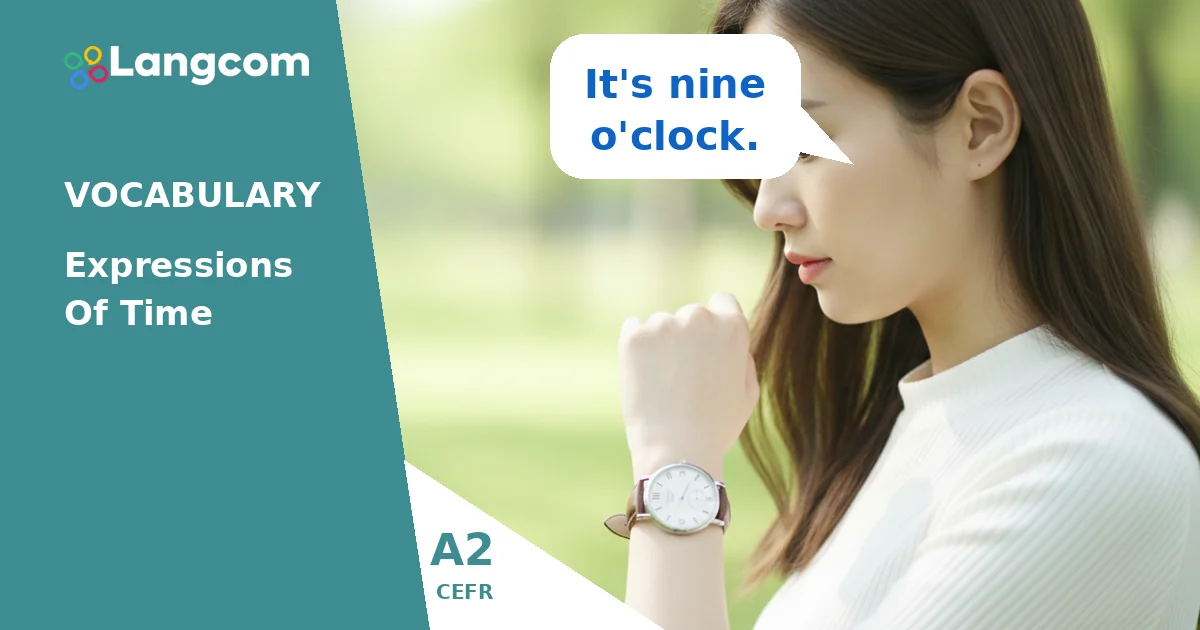

How Do We Ask About the Time?
When you want to know the time, you can ask in a few simple ways.
- The most common question is: What time is it?
- You can also ask: Do you have the time?
- If you want to be polite, you can add Excuse me, … at the beginning.
✍️ Not sure which level you are?
Take our free placement test and get personalized feedback from certified Cambridge examiners.
Пройдите наш БЕСПЛАТНЫЙ тест на определение местаThe Basics: "O'clock"
Мы используем o'clock for exact hours. This means there are zero minutes past the hour.
- Использование o'clock only with full hours, like 1, 2, 3, etc.
- It is always number + o'clock.
Minutes Past the Hour: "Past"
When the minutes are from 1 to 30, we use the word past. We say the minutes first, then past, then the hour.
- For example, for 7:10, we say It's ten past seven.
- For 2:25, we say It's twenty-five past two.
Minutes To the Hour: "To"
When the minutes are from 31 to 59, we use the word to. We say how many minutes are left until the next hour.
- For example, for 7:50, there are 10 minutes until 8 o'clock. We say It's ten to eight.
- For 2:40, there are 20 minutes until 3 o'clock. We say It's twenty to three.
Special Times: "Half Past" and "Quarter"
Some times have special words:
- For 15 minutes past the hour, we say a quarter past. For example, 3:15 is a quarter past three.
- For 30 minutes past the hour, we say half past. For example, 5:30 is half past five.
- For 45 minutes past the hour (which is 15 minutes to the next hour), we say a quarter to. For example, 6:45 is a quarter to seven.
Digital Time: The Easy Way
You can also tell the time by simply saying the numbers you see. This is often called 'digital time' and is very common.
- Say the hour, then say the minutes.
- For example, 7:10 is seven ten.
- 2:45 is two forty-five.
- For exact hours, you can say seven o'clock или seven hundred.
AM and PM: Morning or Night?
English often uses a 12-hour clock. To avoid confusion, we add AM или PM.
- AM means 'ante meridiem' (before midday). It is for times from midnight (00:00) to midday (12:00).
- PM means 'post meridiem' (after midday). It is for times from midday (12:00) to midnight (00:00).
- Например, 7 AM is seven in the morning. 7 PM is seven in the evening.
| Time | Traditional Way | Digital Way |
|---|---|---|
| 7:00 | It's seven o'clock. | It's seven hundred. |
| 9:15 | It's a quarter past nine. | It's nine fifteen. |
| 1:30 | It's half past one. | It's one thirty. |
| 4:45 | It's a quarter to five. | It's four forty-five. |
| 6:50 | It's ten to seven. | It's six fifty. |
Примеры
- It's nine o'clock.
- It's twenty past one.
- It's a quarter past four.
- It's half past ten.
- It's five to six.
- It's a quarter to two.
- It's three thirty-five.
- My class starts at 8 AM.
- The shop closes at 9 PM.
Практика
Ready to earn your certificate?
Langcom prepares students for Cambridge, IELTS, TOEFL, DELE, SIELE and Michigan exams.
Get started with LangcomРаспространенные ошибки у носителей испанского языка
Many Spanish speakers make a few common mistakes when telling the time in English:
- Using 'the' with time: Do not say at the five o'clock. Правильный способ — это at five o'clock.
- Direct translation of 'y cuarto' or 'menos cuarto': Do not say it's two and quarter for 2:15. The correct way is It's a quarter past two или It's two fifteen. For 2:45, do not say it's two less quarter. Say It's a quarter to three или It's two forty-five.
- Confusing 'past' and 'to': Remember past is for minutes 1-30, and to is for minutes 31-59 (to the next hour).
Часто задаваемые вопросы
What is "o'clock"?
O'clock means 'of the clock'. We use it only for exact hours, like It's three o'clock (3:00).
When do I use "past" and "to"?
Использование past for minutes 1 to 30 after the hour (e.g., ten past five for 5:10). Use to for minutes 31 to 59, referring to the minutes before the next hour (e.g., ten to five for 4:50).
What is the difference between "AM" and "PM"?
AM is for times from midnight to noon (morning). PM is for times from noon to midnight (afternoon and night). For example, 7 AM is morning, 7 PM is evening.
How do I tell the time for the A2 Key exam?
For the A2 Key exam, you should understand both traditional (e.g., half past, quarter to) and digital ways (e.g., three thirty). You might hear or need to say the time in listening or speaking tasks.
Can I use numbers only to tell the time?
Yes, saying the numbers (e.g., It's four thirty for 4:30) is very common and perfectly acceptable in most situations. This is the 'digital' way of telling time.



0 Комментариев