
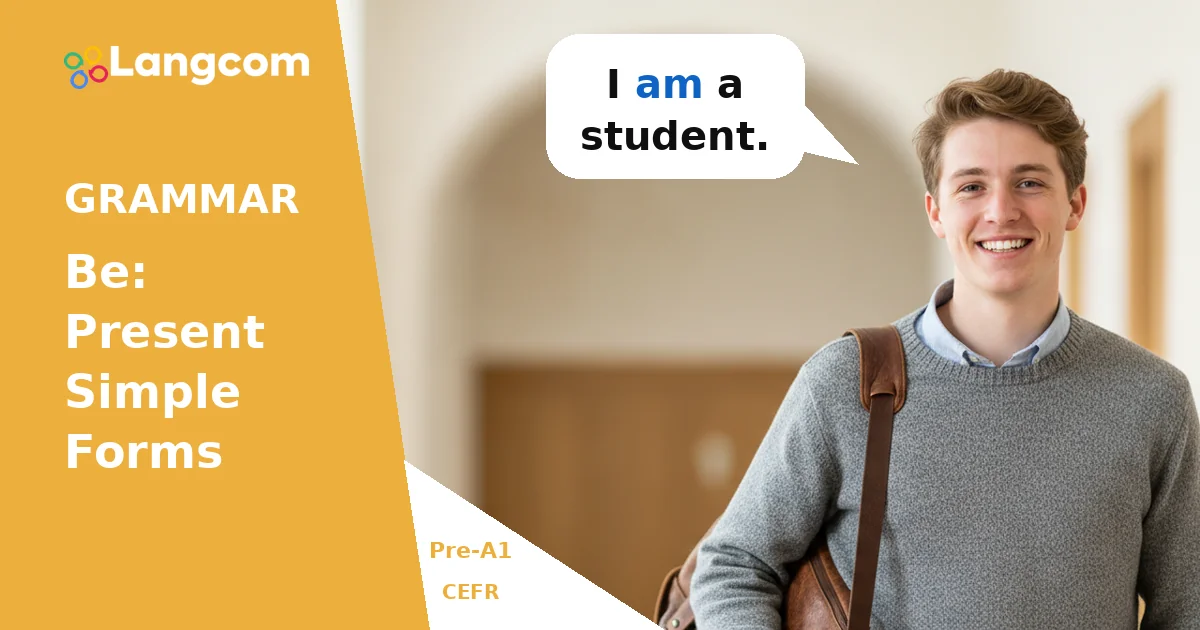

What is the Verb Be?
The verb be is very common in English. It helps you describe things and people. It also tells you where things are.
Think of be like “ser” and “estar” in Spanish. English uses only one verb for both ideas.
🎓 Aprenda inglês com o método misto
Grupos pequenos · Tutor de IA 24 horas por dia, 7 dias por semana · Preparação para os exames de Cambridge
Planos de $39 $79 por mês
How Do We Use Be in Positive Sentences?
The verb be changes its form depending on the subject. There are three forms for the present simple:
- Utilizamos am with I.
- Exemplo: I am happy.
- Utilizamos is with he, she, it, and singular nouns (one person, one thing).
- Exemplo: He is a student.
- Exemplo: It is cold.
- Utilizamos are with you, we, they, and plural nouns (more than one person, more than one thing).
- Exemplo: You are kind.
- Exemplo: They are friends.
How Do We Use Be in Negative Sentences?
To make a sentence negative, we add not after the verb be.
- With I: am not
- Exemplo: I am not sad.
- With he, she, it: is not
- Exemplo: She is not from Spain.
- With you, we, they: are not
- Exemplo: We are not tired.
What Are Contractions with Be?
In spoken English and informal writing, we often use contractions. Contractions are shorter forms of words.
- For positive sentences:
- I am torna-se I’m (e.g., I’m a student.)
- He is torna-se He’s (e.g., He’s tall.)
- She is torna-se She’s (e.g., She’s my sister.)
- It is torna-se It’s (e.g., It’s sunny.)
- You are torna-se You’re (e.g., You’re welcome.)
- We are torna-se We’re (e.g., We’re friends.)
- They are torna-se They’re (e.g., They’re at home.)
- For negative sentences:
- I am not torna-se I’m not (e.g., I’m not hungry.)
- He is not torna-se He isn’t ou He’s not (e.g., He isn’t here. ou He’s not here.)
- She is not torna-se She isn’t ou She’s not
- It is not torna-se It isn’t ou It’s not
- You are not torna-se You aren’t ou You’re not (e.g., You aren’t right. ou You’re not right.)
- We are not torna-se We aren’t ou We’re not
- They are not torna-se They aren’t ou They’re not
When Do We Use the Verb Be?
Utilizamos be for many things. Here are some common uses:
- To talk about identity or names:
- I am Maria.
- He is a doctor.
- To talk about age:
- She is ten years old.
- They are 25.
- To talk about feelings or descriptions:
- We are happy.
- It is a big house.
- To talk about location:
- You are at home.
- The book is on the table.
| Subject | Positive Form | Negative Form | Positive Contraction | Negative Contraction |
|---|---|---|---|---|
| I | am | am not | I’m | I’m not |
| He / She / It | is | is not | He’s / She’s / It’s | isn’t / He’s not / She’s not / It’s not |
| You / We / They | are | are not | You’re / We’re / They’re | aren’t / You’re not / We’re not / They’re not |
Exemplos
- I am a student.
- He is my brother.
- She is happy.
- It is a cat.
- You are tall.
- We are friends.
- They are in the park.
- I am not tired.
- He isn’t here.
- They aren’t sad.
Prática
💬 Precisa de orientação personalizada?
Como Centro Autorizado de Preparação para os Exames de Cambridge, podemos orientá-lo na escolha do curso e da certificação mais adequados. Entre em contato com nossos orientadores hoje mesmo.
Converse com um consultor pelo WhatsAppErros comuns entre falantes de espanhol
Spanish speakers sometimes make these mistakes with be:
- Using have for age: In Spanish, you say “Tengo X años”. In English, we use be.
- Errado: I have 10 years.
- Direita: I am 10 years old.
- Forgetting the subject pronoun: In Spanish, you can often omit the subject (e.g., “Es feliz”). In English, you always need a subject.
- Errado: Is happy.
- Direita: He is happy. ou She is happy.
- Confuso ser e estar: Remember, English uses only be for both.
- Spanish: “Soy alto” (ser) and “Estoy cansado” (estar).
- English: I am tall. e I am tired.
Perguntas frequentes
What are the three present forms of be?
The three present forms are am, is, e are.
How do I make I am negative?
You add not: I am not ou I’m not.
Can I use isn’t and is not?
Yes, isn’t is a contraction for is not. Both are correct, but isn’t is more common in speaking.
When do I use is?
You use is with singular subjects like he, she, it, or one person/thing (e.g., The dog is big.).

0 Comentários