
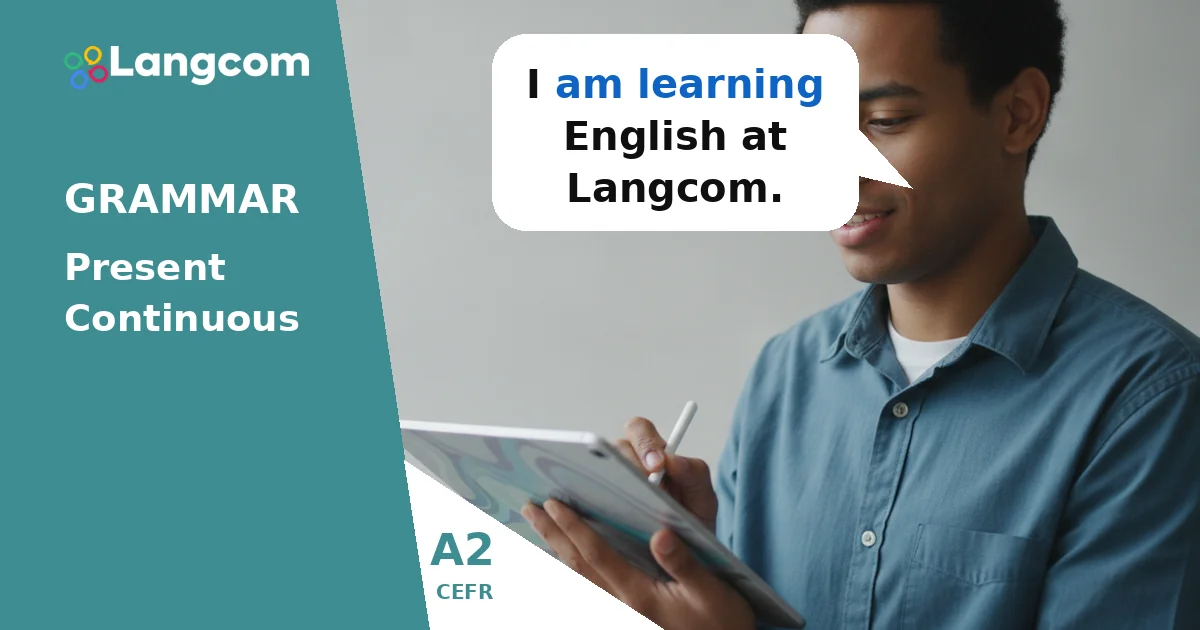

The Present Continuous tense describes actions happening right now, at the moment of speaking. It helps you talk about things that are in progress. For example, if you are reading this blog post, you would say, “I am reading.” This tense is also used for temporary situations, like “She is living in London for a year,” and for future plans that are already arranged, such as “We are meeting friends tonight.” To form the Present Continuous, you combine the verb “to be” (am, is, or are) with the -ing form of the main verb. Understanding this tense is key for A2 English learners to communicate effectively about ongoing events.
What is the Present Continuous Tense?
The Present Continuous tense helps us talk about things that are happening at a specific moment. It shows that an action is in progress.
- We use it for actions happening now.
- We use it for actions happening around now, but maybe not at this exact second.
- We can also use it for temporary situations.
- Sometimes, it describes future plans that are already decided.
✍️ Not sure which level you are?
Take our free placement test and get personalized feedback from certified Cambridge examiners.
Faça nosso teste de nivelamento GRATUITOHow Do We Form the Present Continuous?
The structure for the Present Continuous is simple. You need two parts:
- The verb “to be” (am, is, or are)
- The main verb with -ing at the end
Look at these examples:
- I am studying.
- You are listening.
- He is working.
Remember these rules for adding -ing:
- Most verbs: Just add -ing (e.g., play → playing, read → reading).
- Verbs ending in -e: Remove the -e, then add -ing (e.g., make → making, live → living).
- Short verbs ending in consonant + vowel + consonant: Double the last consonant, then add -ing (e.no-translation>run → running, swim → swimming).
When to Use the Present Continuous
Here are the main situations where you will use the Present Continuous:
- Actions happening at the moment of speaking: These are things you can see or hear right now. “The children are playing outside.”
- Temporary situations: Actions that are happening for a limited time. “My brother is staying with us this week.”
- Future arrangements: Plans that are already fixed for the near future. “We are having dinner with Maria tomorrow.”
- Changing situations: To describe trends or developments. “The weather is getting warmer.”
Common time expressions used with Present Continuous are now, right now, at the moment, today, this week, this month, tonight, e tomorrow.
Present Continuous: Affirmative, Negative, and Questions
Let’s see how to make sentences in different forms:
Affirmative (Positive)
Uso subject + am/is/are + verb-ing.
- I am watching TV.
- She is listening to music.
- They are studying English.
Negative
Add not after am/is/are.
- I am not working. (or I’m not working.)
- He is not sleeping. (or He isn’t sleeping.)
- We are not eating. (or We aren’t eating.)
Yes/No Questions
Start with Am/Is/Are, then the subject, then the verb-ing.
- Are you waiting for someone?
- Is she reading a book?
- Are they talking?
Wh- Questions
Start with a question word (e.g., What, Where), then am/is/are, then the subject, then the verb-ing.
- What are you doing?
- Where is he going?
- Why are they laughing?
| Subject | Affirmative | Negative | Yes/No Question |
|---|---|---|---|
| I | I am working. | I am not working. | Am I working? |
| You / We / They | You are working. | You are not working. | Are you working? |
| He / She / It | He is working. | He is not working. | Is he working? |
Exemplos
- I am learning English at Langcom.
- The sun is shining brightly today.
- My parents are visiting us next month.
- She isn’t watching TV right now.
- Are you enjoying your coffee?
- What are you cooking for dinner?
Prática
Ready to earn your certificate?
Langcom prepares students for Cambridge, IELTS, TOEFL, DELE, SIELE and Michigan exams.
Get started with LangcomErros comuns entre falantes de espanhol
Spanish speakers often make a few common mistakes with the Present Continuous:
- Using the Present Simple for ongoing actions: In Spanish, you might use the simple present for actions happening now. In English, this is incorrect.
- Incorreto: I work now.
- Correto: I am working now.
- Forgetting the verb ‘to be’: The auxiliary verb am/is/are is essential.
- Incorreto: She reading a book.
- Correto: She is reading a book.
- Not adding ‘-ing’ to the main verb: O -ing ending is crucial for continuous tenses.
- Incorreto: We are play football.
- Correto: We are playing football.
Perguntas frequentes
What is the main use of the Present Continuous?
The main use of the Present Continuous is to talk about actions that are happening right now, at the moment of speaking, or around this time.
What is the basic form of the Present Continuous?
The basic form is subject + am/is/are + verb-ing. Por exemplo, I am eating, She is sleeping, They are studying.
Can the Present Continuous be used for future events?
Yes, it can! We use the Present Continuous for future arrangements that are already planned and decided. For example, “I am meeting my friend tomorrow.”
How is the Present Continuous different from the Present Simple?
The Present Continuous describes actions happening now or temporarily. The Present Simple describes habits, routines, and facts. Por exemplo, “I am reading a book now” (continuous) vs. “I read books every day” (simple).
How might the Present Continuous appear in the A2 Key (KET) exam?
In the A2 Key exam, you might need to use the Present Continuous in Part 6 of Reading and Writing to complete gaps in a text, or in Speaking Part 1 when describing what you are doing or what is happening in a picture.

0 Comentários