
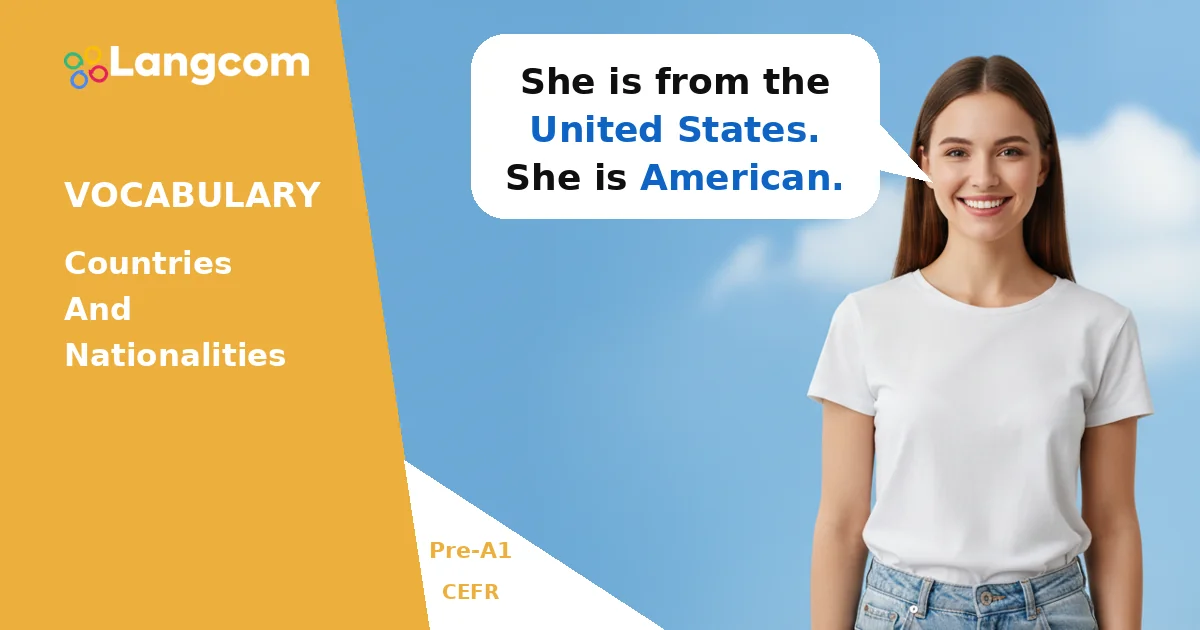

What Are Countries and Nationalities?
Countries are names of places. They are geographical areas with their own governments.
- Examples: Brazil, China, Spain.
Nationalities are words that describe people from those countries. They tell us where a person is from.
- Examples: Brazilian, Chinese, Spanish.
🎓 Aprenda inglês com o método misto
Grupos pequenos · Tutor de IA 24 horas por dia, 7 dias por semana · Preparação para os exames de Cambridge
Planos de $39 $79 por mês
How Do We Use Countries and Nationalities in Sentences?
We use countries and nationalities to talk about origin. This is very useful when you meet new people.
- Uso “I am from + Country” to say your origin.
- Exemplo: I am from Colombia.
- Uso “I am + Nationality” to state your nationality.
- Exemplo: I am Colombian.
You can also ask others:
- Where are you from?
- What is your nationality?
Why Are Countries and Nationalities Important?
Knowing these words helps you introduce yourself and understand others. It is a basic part of conversation.
- You can tell people about yourself: I am from Mexico. I am Mexican.
- You can understand where other people live or were born.
- This vocabulary is essential for travel and making new friends.
| País | Nationality |
|---|---|
| Spain | Spanish |
| Mexico | Mexican |
| United States | American |
| United Kingdom | British |
| Brazil | Brazilian |
| China | Chinese |
| Japan | Japanese |
| Russia | Russian |
| Colombia | Colombian |
Exemplos
- She is from the United States. She is American.
- He is from Japan. He is Japanese.
- They are from Brazil. They are Brazilian.
- Are you from China? Are you Chinese?
- I am from Mexico. I am Mexican.
- We are from the United Kingdom. We are British.
Prática
💬 Precisa de orientação personalizada?
Como Centro Autorizado de Preparação para os Exames de Cambridge, podemos orientá-lo na escolha do curso e da certificação mais adequados. Entre em contato com nossos orientadores hoje mesmo.
Converse com um consultor pelo WhatsAppErros comuns entre falantes de espanhol
Os falantes de espanhol às vezes cometem estes erros:
- Not capitalizing country names and nationalities: In English, these words are always capitalized.
- WRONG: i am spanish.
- RIGHT: I am Spanish.
- WRONG: she is from mexico.
- RIGHT: She is from Mexico.
- Using “the” before a nationality when talking about one person: We do not use “the” with a single person’s nationality.
- WRONG: I am the Spanish.
- RIGHT: I am Spanish.
- (We use “the” for groups, like “the Spanish people” ou “the British”, but not for a single person’s nationality.)
Perguntas frequentes
What is the difference between a country and a nationality?
A country is a place, like Spain. A nationality is a word that describes a person from that country, like Spanish.
Do I always capitalize countries and nationalities?
Yes, always capitalize both country names (e.g., Colombia) and nationality words (e.g., Colombian) in English.
How do I ask someone where they are from?
You can ask: “Where are you from?” ou “What is your nationality?”




0 Comentários