

How do we make ‘be’ negative?
To make a sentence with the verb be negative, you simply add the word not after the verb. This rule applies to all subjects, but today we focus on I, you, e we.
- The basic structure is: Subject + be + not.
🎓 Learn English with the Blended method
Grupos pequenos · Tutor de IA 24 horas por dia, 7 dias por semana · Preparação para os exames de Cambridge
Planos de $39 $79 por mês
What are the negative forms for 'I'?
When the subject is I, the verb be é am. So, the full negative form is I am not.
- In spoken English and informal writing, we often use the contraction: I'm not.
- Exemplo: I'm not from Brazil.
What are the negative forms for 'you' and 'we'?
For the subjects you (singular or plural) and we, the verb be é are. The full negative forms are you are not e we are not.
- The common contracted form for both is aren't.
- Exemplo: You aren't a teacher.
- Exemplo: We aren't from New York.
| Subject | Full Form | Contracted Form |
|---|---|---|
| I | am not | I'm not |
| You | are not | aren't |
| We | are not | aren't |
Exemplos
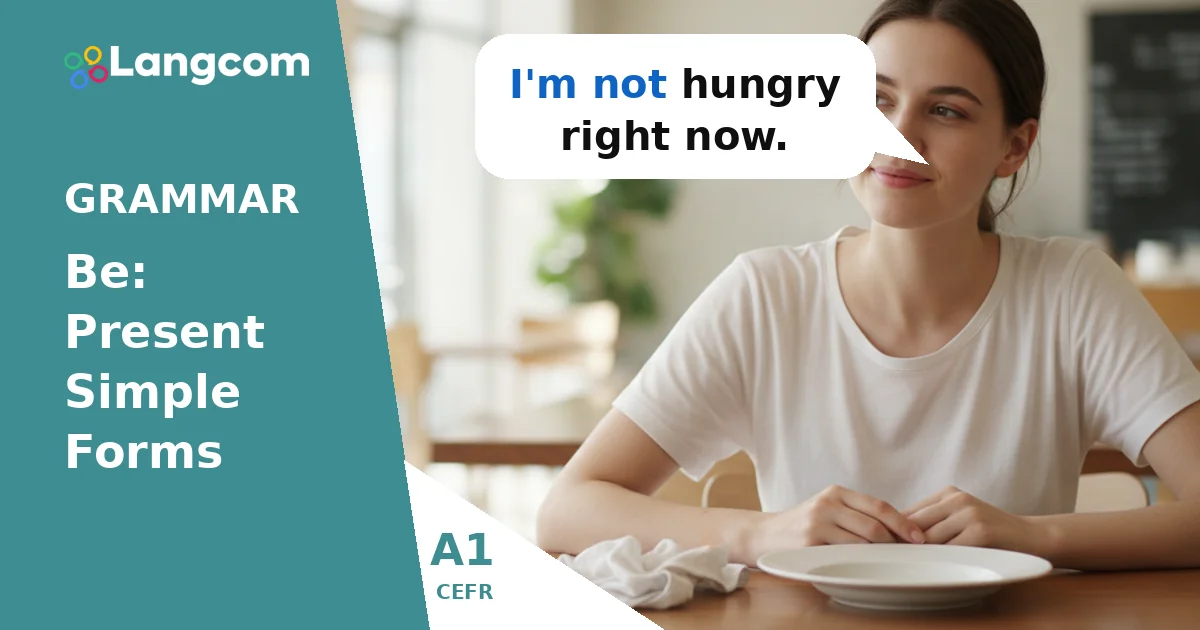
- I'm not hungry right now.
- You aren't late for the class.
- We aren't friends with them.
- I am not a doctor.
- You are not busy this afternoon.
- We are not ready to go.
Prática
💬 Precisa de orientação personalizada?
Como Centro Autorizado de Preparação para os Exames de Cambridge, podemos orientá-lo na escolha do curso e da certificação mais adequados. Entre em contato com nossos orientadores hoje mesmo.
Converse com um consultor pelo WhatsAppErros comuns entre falantes de espanhol
A common mistake for learners is trying to contract am not into amn't. This form is incorrect in standard English. Always use I'm not.
Another point to remember is that you are not e you aren't are both correct. Aren't is more common in speaking, while are not can be used for emphasis or in more formal writing.
Perguntas frequentes
What is the shortest way to say 'I am not'?
The shortest and most common way to say I am not é I'm not.
Can I say 'you are not' instead of 'you aren't'?
Sim, os dois you are not e you aren't are correct. You aren't is more common in everyday conversation.
Why is 'be' important in English?
Be is one of the most important verbs in English. We use it to talk about names, ages, feelings, nationalities, and locations. Learning its forms, including the negative, is fundamental for A1 English.
Is 'amn't' correct?
No, amn't is not a correct contraction in standard English. Always use I'm not.


0 Comentários