

What are Superlative Adjectives?
Superlative adjectives describe one thing that is special in a group. They show which item has the highest or lowest quality.
We use them when we compare three or more things, people, or places.
- For example, if you have three friends, one is the funniest.
- If you visit many cities, one is the most beautiful.
How Do We Form Superlative Adjectives?
The way we form superlative adjectives depends on the length of the adjective.
Short Adjectives (1 or 2 syllables ending in -y)
For most short adjectives, we add -est to the end. Always put the before the adjective.
- tall → the tallest
- old → the oldest
- fast → the fastest
Some spelling rules:
- If the adjective ends in consonant + vowel + consonant, double the last consonant before adding -est.
- big → the biggest
- hot → the hottest
- If the adjective ends in -y, change -y ~へ -i and add -est.
- happy → the happiest
- easy → the easiest
Long Adjectives (2 or more syllables, not ending in -y)
For longer adjectives, we use the most before the adjective. We do not change the adjective itself.
- beautiful → the most beautiful
- interesting → the most interesting
- expensive → the most expensive
Irregular Adjectives
Some adjectives have special forms. You need to learn these.
- good → the best
- bad → the worst
- far → the farthest / the furthest
When Do We Use Superlative Adjectives?
We use superlative adjectives to talk about one item that stands out from a group. This group can be people, places, or things.
- To identify the extreme in a group: Mount Everest is the highest mountain in the world.
- To describe a unique quality: That was the funniest movie I’ve ever seen.
We often use in または of to specify the group.
- Use in for places or groups of people: He is the best student in the class.
- Use of for periods of time or numbers: It was the happiest day of my life.
例
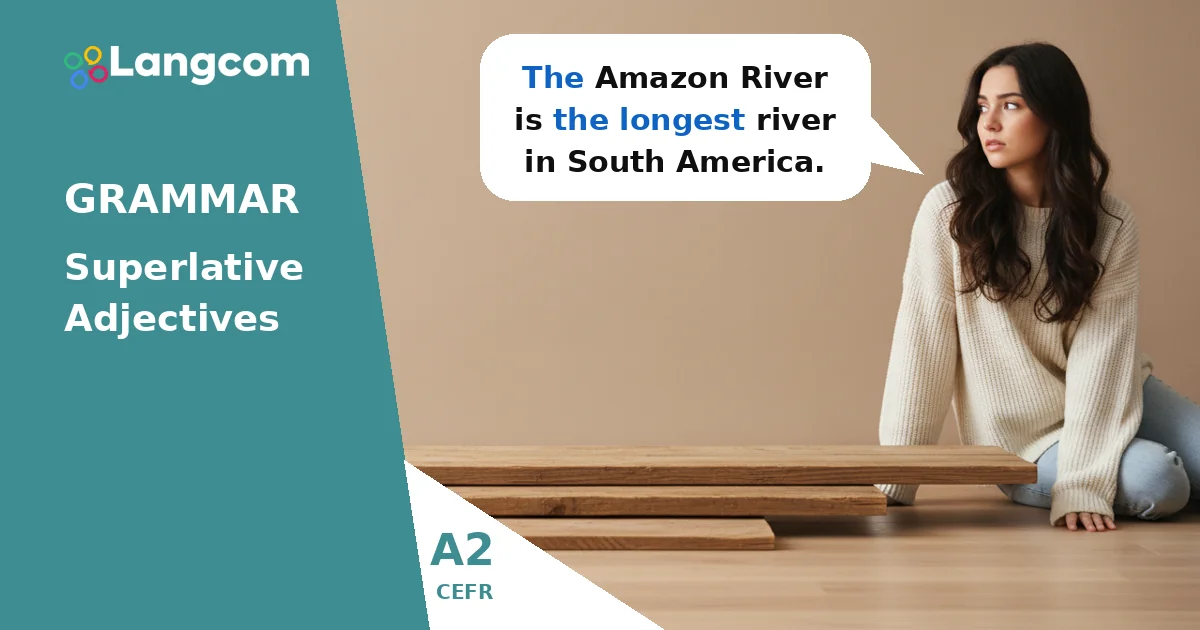
- The Amazon River is the longest river in South America.
- My grandmother is the oldest person in our family.
- Learning English can be the most interesting experience.
- This is the worst weather we’ve had all year.
- She thinks Spanish is the easiest language to learn.
練習
💬 個別のアドバイスが必要ですか?
当校はケンブリッジ試験の公認準備センターとして、皆様に最適なコースや資格取得への道をご案内いたします。ぜひ今すぐアドバイザーにご相談ください。.
WhatsAppでアドバイザーとチャットスペイン語話者がよく犯す間違い
Forgetting ‘the’
In Spanish, you say ‘el más alto’. In English, you must always use the before the superlative adjective.
- 誤り: He is most tall student.
- 正しい: He is the tallest student.
Using ‘most’ with short adjectives
Spanish often uses ‘más’ for all comparisons. In English, remember to use -est for short adjectives.
- 誤り: This is the most big city.
- 正しい: This is the biggest city.
Using ‘more’ instead of ‘best’ or ‘worst’
For irregular adjectives like good そして bad, do not use more または most. Use their special forms.
- 誤り: This is the most good book.
- 正しい: This is the best book.
よくある質問
What is the difference between comparative and superlative adjectives?
Comparative adjectives compare two things (e.g., taller, more beautiful). Superlative adjectives compare three or more things and identify one as the extreme (e.g., the tallest, the most beautiful).
Do I always use ‘the’ with superlative adjectives?
Yes, almost always! You need the before a superlative adjective to show that it is unique in its group. For example, She is the smartest person I know.
Are there any adjectives that can use both -est and ‘the most’?
Yes, some two-syllable adjectives can use both forms, especially those ending in -le, -er, 、または -ow. For example, clever can be the cleverest または the most clever. However, for A2, it’s best to follow the main rules: -est for short ones, the most for long ones.



コメント 0 件