
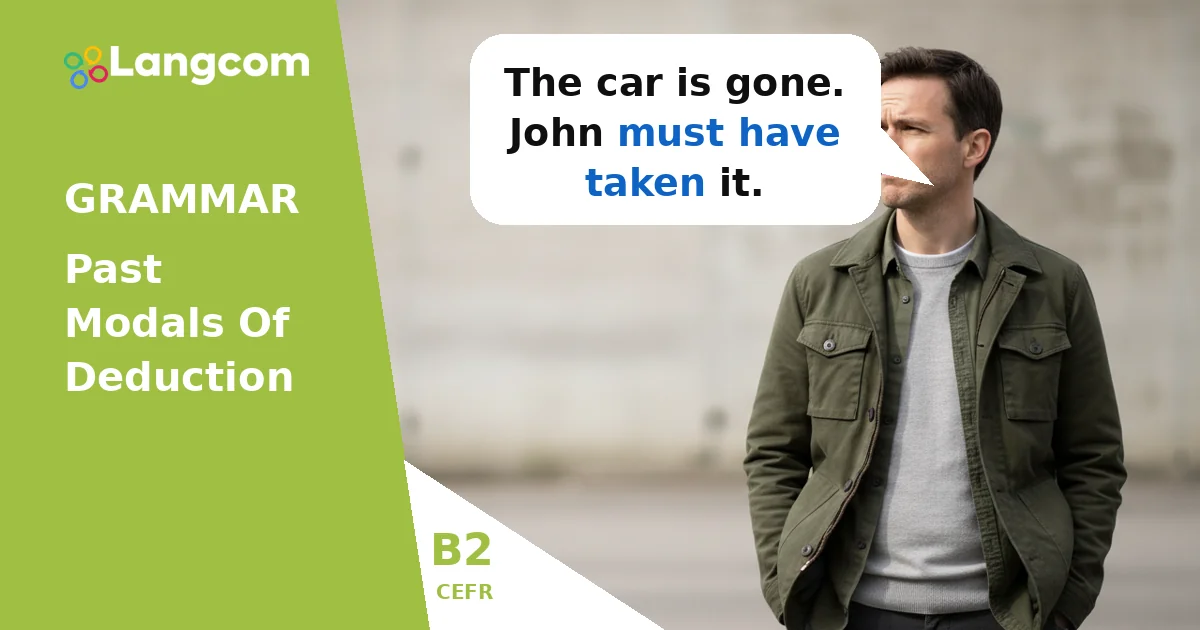

What Are Past Modals of Deduction?
Past modals of deduction are special verb forms that allow us to talk about how likely something was in the past. We use them to express our certainty or uncertainty about past events.
You use these structures when you don’t know exactly what happened, but you can make a logical guess based on the information you have now.
How Do We Form Past Modals of Deduction?
The basic structure for all past modals of deduction is simple:
- Modal Verb + have + Past Participle (V3)
The modal verb changes depending on how certain you are. The have and the past participle always stay the same.
When to Use Must Have + Past Participle
We use must have + past participle when we are almost 100% sure that something happened in the past. We have strong evidence for our conclusion.
- 例: “The lights are off and the door is locked. They must have left.” (You are very sure they left.)
- 例: “She looks exhausted. She must have worked all night.” (You are very sure she worked all night.)
When to Use May Have, Might Have, Could Have + Past Participle
We use may have + past participle, might have + past participle, 、または could have + past participle when we think something was possible in the past, but we are not very certain (around 50% sure).
- These three modals are often interchangeable, meaning you can use any of them to express possibility.
- 例: “I can’t find my phone. I may have left it at home.” (It’s possible you left it at home.)
- 例: “He didn’t answer his phone. He might have been sleeping.” (It’s possible he was sleeping.)
- 例: “They didn’t come to the party. They could have forgotten about it.” (It’s possible they forgot.)
When to Use Can’t Have + Past Participle
We use can’t have + past participle when we are almost 100% sure that something did NOT happen in the past. We have strong evidence that makes it impossible.
- 例: “She was with me all day. She can’t have stolen your wallet.” (It’s impossible she stole it.)
- 例: “He knows the way perfectly. He can’t have gotten lost.” (It’s impossible he got lost.)
Negative Forms for Possibility: May Not Have そして Might Not Have
To express a possible negative event in the past, we use may not have + past participle または might not have + past participle.
- This is different from can’t have, which expresses strong certainty that something did not happen.
- 例: “She didn’t reply to my email. She may not have seen it.” (It’s possible she didn’t see it.)
- 例: “They aren’t here yet. They might not have received the invitation.” (It’s possible they didn’t receive it.)
| Modal Form | Level of Certainty | Example |
|---|---|---|
| must have + V3 | Almost 100% sure (positive) | She must have forgotten. |
| may have + V3 | Possible (around 50% sure) | He may have gone home. |
| might have + V3 | Possible (around 50% sure) | They might have missed the bus. |
| could have + V3 | Possible (around 50% sure) | I could have left it there. |
| can’t have + V3 | Almost 100% sure (negative) | You can’t have seen him. |
| may not have + V3 | Possible (negative) | She may not have understood. |
| might not have + V3 | Possible (negative) | They might not have known. |
例
- The car is gone. John must have taken it.
- I saw her leave an hour ago. She can’t have finished her work already.
- He looks upset. He might have heard the bad news.
- They could have missed their train, that’s why they’re late.
- She didn’t answer her phone. She may not have heard it ring.
- The window is broken. Someone must have thrown a rock.
- It was a secret. He couldn’t have known about it.
練習
スペイン語話者がよく犯す間違い
Spanish speakers often make a few common mistakes when using past modals of deduction:
- Using the wrong verb form: A common error is to use a simple past tense after the modal, like “He must have went” instead of “He must have gone.” Remember, it’s always modal + have + past participle.
- Confusing can’t have with couldn’t have for strong deduction: While couldn’t have can sometimes express impossibility, can’t have is much stronger and more common for expressing a firm conclusion that something did not happen. For example, “She can’t have been at the party; I saw her at home.” is stronger than “She couldn’t have been at the party.”
- Direct translation from Spanish: Sometimes, learners translate directly from Spanish structures like “deber de haber” (must have) but might confuse it with “tener que haber” (have to have), which implies obligation, not deduction. Always focus on the level of certainty in English.
よくある質問
What is the main difference between must have そして may have?
The main difference is the level of certainty. We use must have when we are almost 100% sure about a past event based on strong evidence. We use may have (or might have, could have) when we are only 50% sure, expressing a possibility.
Can I use couldn’t have instead of can’t have?
Yes, you can use couldn’t have to express impossibility in the past, similar to can’t have. However, can’t have often conveys a stronger, more definite conclusion that something did not happen. For example, “He can’t have seen me” is a very firm deduction, while “He couldn’t have seen me” might suggest it was impossible due to circumstances, but perhaps slightly less absolute.
Are may have そして might have always interchangeable?
For expressing possibility in the past, may have そして might have are largely interchangeable. There is a very subtle difference where might have can sometimes suggest a slightly lower probability than may have, but in most everyday conversations, you can use either.
How do past modals of deduction relate to B2 English exams?
Past modals of deduction are important for B2 exams, especially in tasks that require expressing opinions, making inferences, or speculating about past events. For example, in writing tasks or speaking parts, you might need to analyze a situation and make logical deductions about what must have happened または could have happened.




コメント 0 件