

How Do We Make Questions in English?
In English, we often change the word order to make a question. We move the first verb or a special “helper” verb to the beginning of the sentence.
This is different from some languages where you only change your voice. In English, the word order is very important for questions.
- For statements: You are happy.
- For questions: Are you happy?
Questions with the Verb “Be” (Am, Is, Are)
The verb be is special. To ask a question, you simply put am, is, 、または are before the subject.
- Statement: She is a student.
- Question: Is she a student?
Short answers:
- Yes, I am. / No, I’m not.
- Yes, you are. / No, you aren’t.
- Yes, he is. / No, he isn’t.
Questions with “Have got” (Possession)
To ask about possession using have got, move have before the subject.
- Statement: They have got a car.
- Question: Have they got a car?
Short answers:
- Yes, I have. / No, I haven’t.
- Yes, she has. / No, she hasn’t.
Questions with “Can” (Ability)
Can is a modal verb. To make a question, put can before the subject.
- Statement: He can swim.
- Question: Can he swim?
Short answers:
- Yes, I can. / No, I can’t.
- Yes, they can. / No, they can’t.
Questions with “Do” and “Does” (Simple Present)
For most other verbs in the simple present, we use the auxiliary verb do または does. Put do/does before the subject, and the main verb stays in its base form.
- Statement: You like pizza.
- Question: Do you like pizza?
- Statement: She works here.
- Question: Does she work here?
Short answers:
- Yes, I do. / No, I don’t.
- Yes, he does. / No, he doesn’t.
Questions with “There is” / “There are” (Existence)
To ask if something exists, we invert there そして is/are.
- Statement: There is a book.
- Question: Is there a book?
- Statement: There are many people.
- Question: Are there many people?
Short answers:
- Yes, there is. / No, there isn’t.
- Yes, there are. / No, there aren’t.
| Question Type | Question Example | Positive Short Answer | Negative Short Answer |
|---|---|---|---|
| Be | Are you happy? | Yes, I am. | No, I’m not. |
| Have got | Have you got a cat? | Yes, I have. | No, I haven’t. |
| There is/are | Is there a mouse here? | Yes, there is. | No, there isn’t. |
| Can | Can you dance? | Yes, I can. | No, I can’t. |
| Do/Does | Do you like parties? | Yes, I do. | No, I don’t. |
例
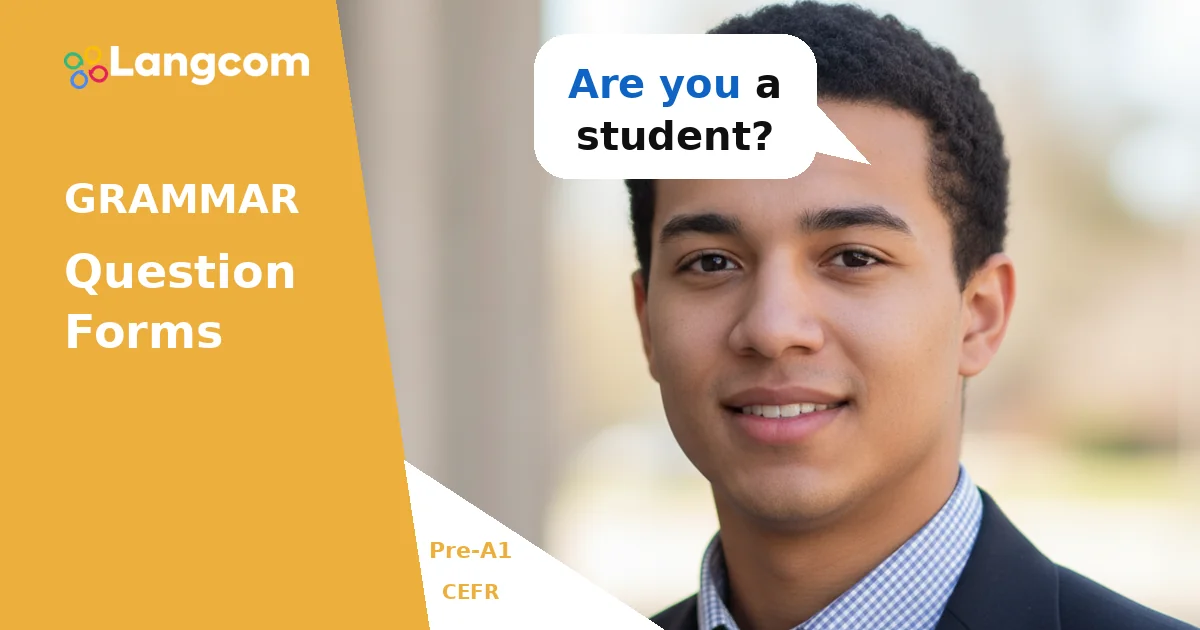
- Are you a student?
- Is he happy?
- Have you got a pen?
- Has she got a dog?
- Can you speak English?
- Can they help us?
- Do you live in Madrid?
- Does he play football?
- Is there a park nearby?
- Are there chairs in the room?
練習
💬 個別のアドバイスが必要ですか?
当校はケンブリッジ試験の公認準備センターとして、皆様に最適なコースや資格取得への道をご案内いたします。ぜひ今すぐアドバイザーにご相談ください。.
WhatsAppでアドバイザーとチャットスペイン語話者がよく犯す間違い
Spanish speakers sometimes make these mistakes:
- Missing “Do” or “Does”: In Spanish, you can often just change your voice to ask a question. In English, you need do または does for most verbs in the present simple.
- Wrong: You like coffee?
- Right: Do you like coffee?
- Incorrect Word Order: Remember to put the first verb or helper verb before the subject.
- Wrong: He is tall?
- Right: Is he tall?
- Incorrect “Have got” Question Form: When using have got for possession, remember to invert have and the subject.
- Wrong: You have got a pet?
- Right: Have you got a pet?
よくある質問
What is a yes/no question?
A yes/no question is a question that you can answer with Yes または No. For example, Are you hungry?
Why do we use “do” or “does”?
当社では do または does as “helper verbs” for most verbs in the simple present tense when we ask questions or make negative sentences. For example, Do you speak English?
How do I know if I need “is” or “are”?
使用方法 is for singular subjects (one person/thing) and are for plural subjects (more than one person/thing) or with you. For example, Is he here? but Are they here?
Can I just say “Yes” or “No”?
Yes, you can. But in English, it is more polite and natural to use a short answer like Yes, I am または No, I don’t.



コメント 0 件