
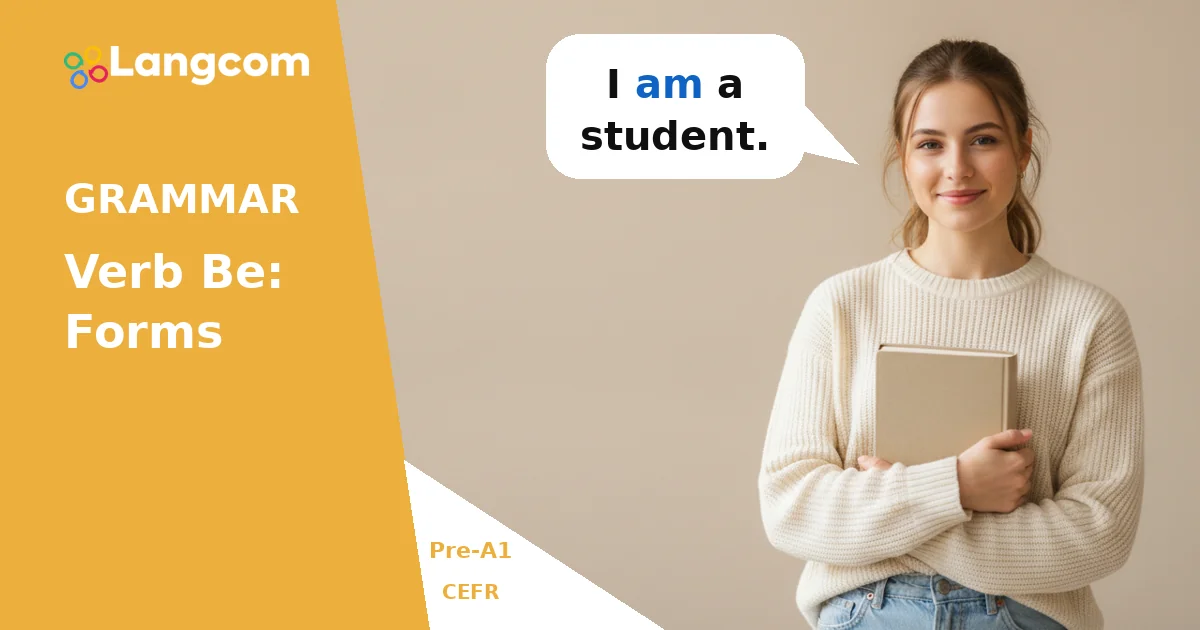

What is the English verb To Be?
The verb to be is very common in English. It helps us talk about many things.
- It means “ser” or “estar” in Spanish.
- It tells us about identity, age, feelings, and location.
In the present simple, to be has three forms: am, is, 、および are.
How do we use Am, Is, and Are?
The form of to be changes with the subject. This is called subject-verb agreement.
- 使用方法 am only with the pronoun I.
- 使用方法 is with he, she, it, and singular nouns (like “the dog” or “my friend”).
- 使用方法 are with you, we, they, and plural nouns (like “the students” or “my parents”).
When do we use the verb To Be?
当社では am, is, are for many different situations.
- To say who someone is or what something is (Identity):
- I am a student.
- He is a doctor.
- It is a book.
- To say how old someone is (Age):
- I am ten years old.
- She is twenty.
- To describe feelings or states (Feelings/States):
- We are happy.
- He is tired.
- To say where someone or something is (Location):
- They are at home.
- The cat is on the chair.
- To describe people or things (Description):
- The weather is cold.
- You are very kind.
What are the short forms of To Be?
In spoken English and informal writing, we often use short forms, called contractions. They make sentences shorter and faster.
- I am ~になる I’m
- He is ~になる He’s
- She is ~になる She’s
- It is ~になる It’s
- You are ~になる You’re
- We are ~になる We’re
- They are ~になる They’re
These short forms are very common. Try to use them!
| Subject | Verb Form | 例 |
|---|---|---|
| I | am | I am happy. |
| He | is | He is a boy. |
| She | is | She is my sister. |
| It | is | It is cold. |
| You | are | You are smart. |
| We | are | We are friends. |
| They | are | They are students. |
例
- I am a student.
- She is happy.
- They are at school.
- He is ten years old.
- We are friends.
- It is a big dog.
練習
💬 個別のアドバイスが必要ですか?
当校はケンブリッジ試験の公認準備センターとして、皆様に最適なコースや資格取得への道をご案内いたします。ぜひ今すぐアドバイザーにご相談ください。.
WhatsAppでアドバイザーとチャットスペイン語話者がよく犯す間違い
スペイン語を話す人たちは、時々次のような間違いを犯しがちです。 to be because of differences between English and Spanish.
- Using have for age: In Spanish, you use “tener” (to have) for age. In English, we use to be.
- Wrong: I have ten years.
- Correct: I am ten years old.
- Forgetting to be: In Spanish, sometimes the verb “ser” or “estar” is implied. In English, you always need to be.
- Wrong: He happy.
- Correct: He is happy.
- Confusing is そして are: Remember is is for one person/thing, are is for more than one.
- Wrong: My parents is at home.
- Correct: My parents are at home.
よくある質問
What are the three forms of To Be in the present?
The three forms are am, is, 、および are.
When do I use Am?
You use am only with the subject I, for example, I am a student.
Can I use Is for “you”?
No, you must use are ~のために you. For example, You are nice.
What is the short form of they are?
The short form of they are は they’re.
Does To Be mean “tener” for age?
No, to be means “ser” or “estar”. For age, English uses to be, not have. For example, I am twelve years old.


コメント 0 件