

How Do We Talk About Getting Sick?
When you start to feel unwell, there are specific English phrases and words you can use to describe your condition.
- To come down with something means to start to suffer from an illness, usually one that is not very serious. It suggests the beginning of an illness.
- An infection is a disease in a part of your body that is caused by bacteria or a virus. You can get an infection.
- An ache is a continuous, dull pain in a part of your body. It can be a verb or a noun. Common examples include headache, stomach ache, 、または back ache.
✍️ Not sure which level you are?
無料のレベル判定テストを受けて、ケンブリッジ認定試験官からあなたに合わせたフィードバックを受け取りましょう。.
無料プレイスメント・テストを受けるWhat About Injuries and Accidents?
Accidents happen, and it’s important to know how to describe the injuries you might get.
- To strain a muscle or part of your body means to injure it by using it too much or by twisting it. Strain can also be a noun, referring to the injury itself.
- A bruise is a dark mark that appears on your skin after you have fallen or been hit. You can also use bruise as a verb, meaning to cause a bruise.
- A scar is a permanent mark left on the skin after an injury or operation has healed. Like bruise, scar can also be used as a verb, meaning to mark with a scar.
How Do We Describe Symptoms?
Symptoms are the signs that tell you something is wrong with your body. Here are some common ones:
- To faint または pass out means to suddenly lose consciousness for a short time, usually because of a lack of blood to the brain. These two verbs are often interchangeable.
- If you feel dizzy, you feel as if everything is turning around and that you are going to fall. It’s an adjective describing a sensation.
- If someone looks pale, their face or skin has less color than usual. This often happens when they are ill, tired, or frightened.
| Word/Phrase | Type | Meaning |
|---|---|---|
| come down with | Phrasal verb | To start to suffer from an illness |
| infection | Noun | A disease caused by bacteria or a virus |
| ache | Noun/Verb | A continuous, dull pain; to feel a continuous dull pain |
| strain | Verb/Noun | To injure a muscle by overusing it; the injury itself |
| bruise | Noun/Verb | A dark mark on the skin from a hit; to cause a bruise |
| scar | Noun/Verb | A permanent mark on the skin after healing; to mark with a scar |
| faint | Verb | To suddenly lose consciousness for a short time |
| pass out | Phrasal verb | To suddenly lose consciousness for a short time |
| dizzy | Adjective | Feeling as if everything is turning around, about to fall |
| pale | Adjective | Having less color in the face or skin than usual |
例
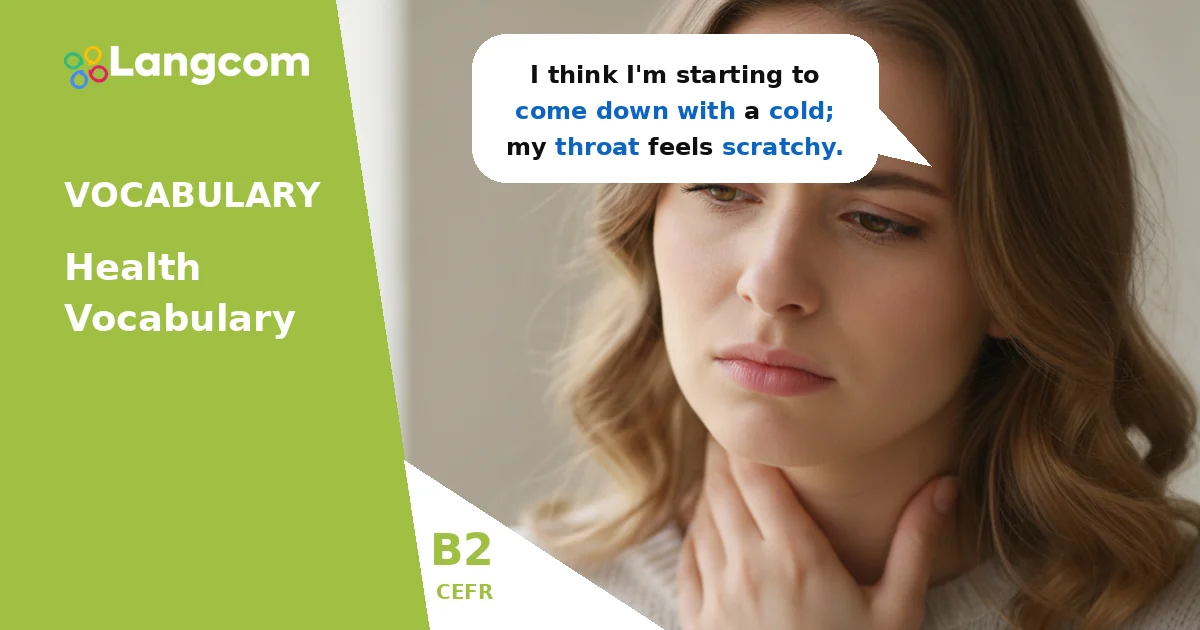
- I think I’m starting to come down with a cold; my throat feels scratchy.
- The doctor said I had a bacterial infection and prescribed antibiotics.
- After lifting heavy boxes, I had a terrible ache in my lower back.
- She strained a ligament in her knee while playing tennis.
- He got a big bruise on his arm after bumping into the door.
- The cut was deep, and now he has a small scar on his forehead.
- The heat made me feel dizzy, and I almost fainted.
- When the bad news came, her face went very pale.
練習
Ready to earn your certificate?
Langcom prepares students for Cambridge, IELTS, TOEFL, DELE, SIELE and Michigan exams.
Get started with Langcomスペイン語話者がよく犯す間違い
- Using ‘I am dizzying’ instead of ‘I am dizzy’: In Spanish, you might say ‘Estoy mareado/a’. In English, dizzy is an adjective, so you say I am dizzy. You do not use ‘dizzy’ as a verb in this context.
- Saying ‘I have an ache in my head’ instead of ‘I have a headache’: While grammatically correct, it’s more natural to use the compound noun headache, stomach ache, etc.
- Confusing ‘strain’ with ‘twist’: While both involve injury, strain often refers to overstretching or tearing a muscle or tendon, like straining a hamstring. Twist is more general and often refers to a joint, like twisting an ankle, which could result in a sprain (a ligament injury).
- Using ‘make a bruise’ instead of ‘get a bruise’: We usually say I got a bruise または I have a bruise, not ‘I made a bruise’.
よくある質問
What is the difference between faint そして pass out?
Both faint そして pass out mean to lose consciousness for a short period. They are often interchangeable. Pass out can sometimes sound slightly more informal, but both are commonly used.
Can strain be a noun and a verb?
Yes, strain can be both. As a verb, it means to injure a muscle (e.g., I strained my back). As a noun, it refers to the injury itself (e.g., He suffered a muscle strain).
What is the difference between ache そして pain?
Ache typically refers to a continuous, dull, and often widespread pain (e.g., a dull ache). Pain is a more general term for physical suffering, which can be sharp, sudden, severe, or dull. All aches are a type of pain, but not all pains are aches.
How can I remember all this new vocabulary?
To remember new vocabulary, try using flashcards, writing your own example sentences, discussing health topics with a partner, or listening to English podcasts about health. Active practice is key to making these words part of your active vocabulary.




コメント 0 件