
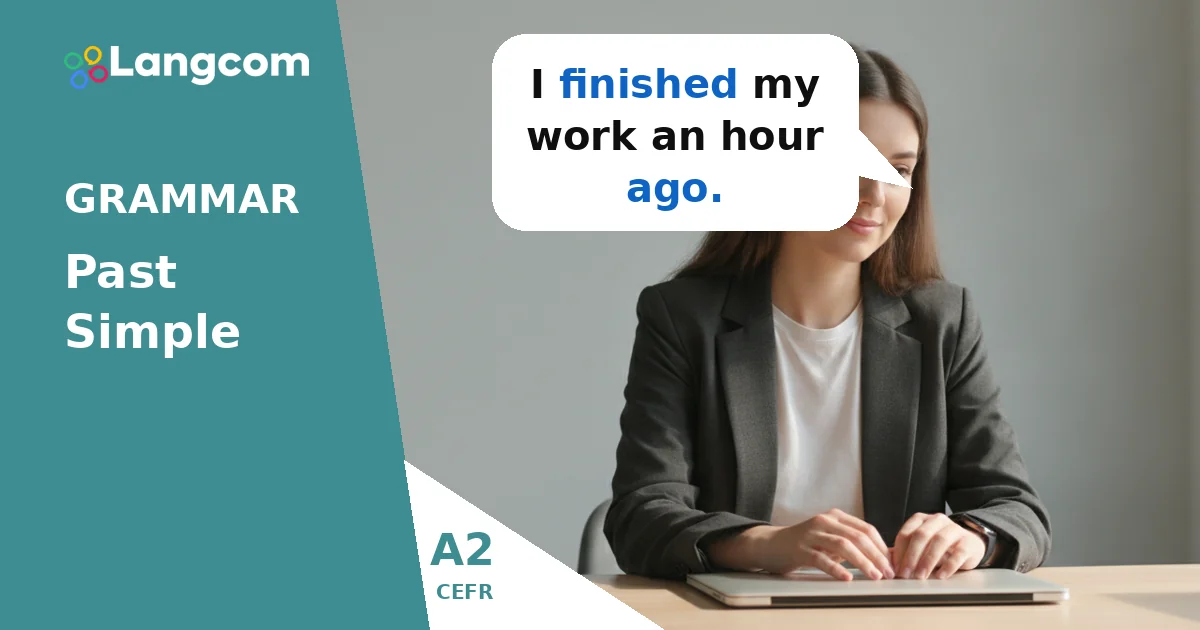

When do we use the Past Simple?
We use the Past Simple to talk about actions or events that happened at a specific time in the past and are now finished. Think of it as describing something that started and ended before ‘now’.
- Use it for completed actions in the past: I walked to school this morning.
- Use it for a series of completed actions: She woke up, ate breakfast, and left for work.
- Use it for past habits or routines: When I was a child, I played outside every day.
- Often used with time expressions like yesterday, last week, two years ago, in 2010.
✍️ Non sai a quale livello ti trovi?
Fai il nostro test di livello gratuito e ricevi un feedback personalizzato da esaminatori certificati Cambridge.
Fai il nostro test di livello GRATUITOHow do we form the Past Simple for Regular Verbs?
Most verbs in English are regular. To form their Past Simple, we usually add -ed to the base form of the verb.
- Most verbs: add -ed. walk → walked, play → played
- Verbs ending in -e: add -d. live → lived, love → loved
- Verbs ending in consonant + y: change y to i and add -ed. study → studied, try → tried
- Verbs ending in vowel + y: just add -ed. play → played, enjoy → enjoyed
- Verbs with one syllable, ending in consonant + vowel + consonant: double the last consonant and add -ed. stop → stopped, plan → planned
What about Irregular Verbs?
Many common verbs in English are irregular. This means they do not follow the -ed rule. You need to learn their Past Simple forms by heart.
Some examples of irregular verbs include:
- go → went
- have → had
- eat → ate
- see → saw
- be → was/were
The verb to be is special: I/he/she/it was, you/we/they were.
How do we make Negative Sentences?
To make a negative sentence in the Past Simple, we use did not (or the short form didn't) followed by the base form of the main verb.
- I didn't go to the party. (NON *I didn't went*)
- They didn't finish their homework.
For the verb to be, we do not use did not. Instead, we use was not (wasn't) or were not (weren't).
- She wasn't happy yesterday.
- We weren't at home last night.
How do we ask Questions?
To ask a question in the Past Simple, we use Did before the subject, and then the base form of the main verb.
- Did you enjoy the film?
- Did they visit their grandparents?
For the verb to be, we put Was oppure Were before the subject.
- Was he busy?
- Were you tired?
For 'Wh-' questions (e.g., What, Where, When), the 'Wh-' word comes first.
- Where did you go on holiday?
- When did she arrive?
| Base Form | Past Simple |
|---|---|
| be | was/were |
| become | became |
| begin | began |
| break | broke |
| buy | bought |
| come | came |
| do | did |
| drink | drank |
| eat | ate |
| find | found |
| get | got |
| give | gave |
| go | went |
| have | had |
| know | knew |
| make | made |
| meet | met |
| read | read |
| say | said |
| see | saw |
| take | took |
| tell | told |
| think | thought |
| win | won |
| write | wrote |
Esempi
- I finished my work an hour ago.
- She studied English for three years.
- They went to the beach last summer.
- We didn't see him yesterday.
- Did you call me?
- My parents lived in a small town.
- He was a student here in 2020.
- What did you do last weekend?
Esercitazione
Ready to earn your certificate?
Langcom prepares students for Cambridge, IELTS, TOEFL, DELE, SIELE and Michigan exams.
Get started with LangcomErrori comuni per chi parla spagnolo
Many learners, especially Spanish speakers, make these common mistakes with the Past Simple:
- Using the past form after did not oppure did: Remember to always use the base form of the verb after did/didn't.
❌ I didn't went to the shop.
✅ I didn't go to the shop. - Confuso did con was/were: Did is for other verbs, was/were is for the verb to be.
❌ Did you happy?
✅ Were you happy? - Using Present Perfect for completed actions at a specific past time: In Spanish, the 'pretérito perfecto' can sometimes translate to English Past Simple. Always use Past Simple for actions finished at a clear past time.
❌ I have bought a new car yesterday.
✅ I bought a new car yesterday.
Domande frequenti
What is the Past Simple used for?
The Past Simple is used to talk about actions or events that started and finished at a specific time in the past. It describes things that are completely over, like I ate breakfast this morning.
How do I form regular Past Simple verbs?
For most regular verbs, you add -ed to the base form (e.g., walk → walked). There are small spelling changes for verbs ending in -e, -y, or with a single vowel + consonant pattern.
What are irregular verbs?
Irregular verbs do not follow the -ed rule for the Past Simple. They have unique forms that you need to learn, such as go → went, have → had, oppure see → saw.
How is the Past Simple tested in the A2 Key English exam?
In the A2 Key (KET) exam, you might find tasks that require you to understand or use the Past Simple. This could include reading a short text or blog post and identifying past events, or completing sentences and conversations with the correct Past Simple form of verbs, both regular and irregular.




0 Commenti