
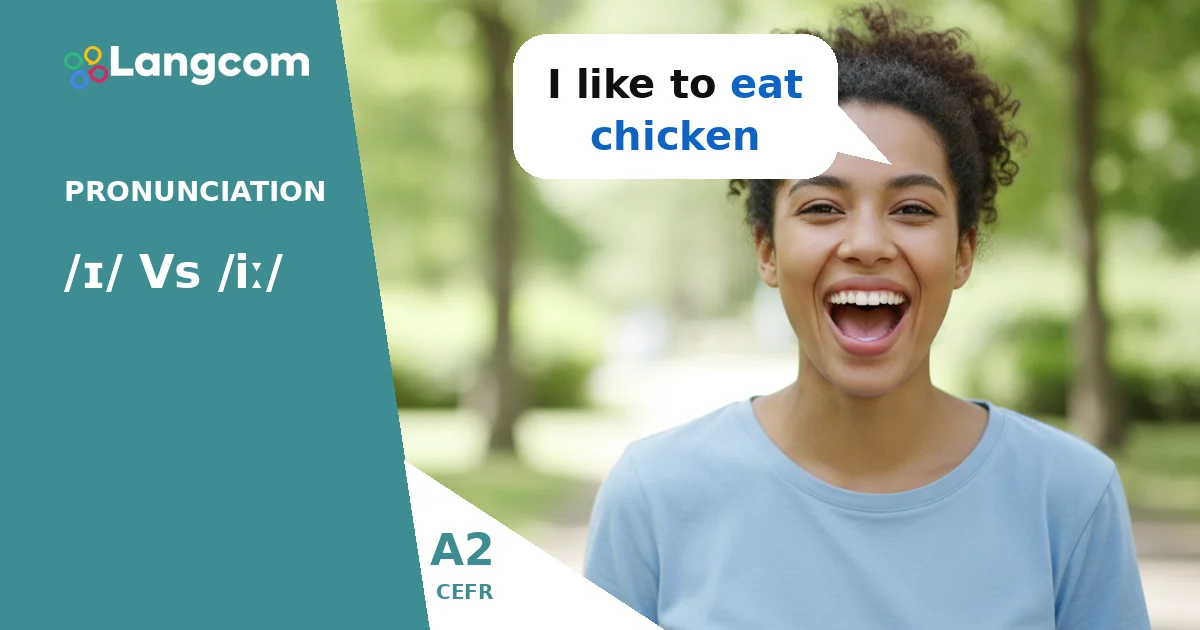

What are the /ɪ/ and /iː/ sounds?
English has many vowel sounds. Today, we focus on two sounds that can be confusing for learners: /ɪ/ e /iː/. They look similar in phonetic symbols, but they sound very different.
Understanding this difference is key to clear pronunciation.
- Il /ɪ/ Sound (Short ‘i’)
- This sound is short and quick.
- Your mouth is relaxed, slightly open.
- Your tongue is relaxed and in the middle of your mouth.
- Think of the ‘i’ in words like fish, sit, big, dinner.
- Il /iː/ Sound (Long ‘ee’)
- This sound is long and held.
- Your mouth is wider, like a smile, and your lips are a bit tense.
- Your tongue is high and pushed forward in your mouth.
- Think of the ‘ee’ in words like tree, feel, eat, beans.
✍️ Non sai a quale livello ti trovi?
Fai il nostro test di livello gratuito e ricevi un feedback personalizzato da esaminatori certificati Cambridge.
Fai il nostro test di livello GRATUITOHow do you make the /ɪ/ sound?
To make the /ɪ/ sound correctly, try these steps:
- Relax your mouth: Do not stretch your lips. Keep them relaxed, just slightly open.
- Relax your tongue: Your tongue should be flat and relaxed in the middle of your mouth, not touching the top or bottom of your mouth too much.
- Make it short: The sound should be very quick, like a short 'i'.
Practice with words like it, is, in, this, milk.
How do you make the /iː/ sound?
To make the /iː/ sound correctly, follow these instructions:
- Smile your mouth: Stretch your lips sideways, as if you are smiling. Your lips should be a little tense.
- Raise your tongue: Push your tongue high and forward in your mouth, almost touching the sides of your upper teeth.
- Make it long: Hold the sound for a little longer than the /ɪ/ sound.
Practice with words like we, she, green, sleep, tea.
Why is it important to distinguish /ɪ/ and /iː/?
Confusing these two sounds can change the meaning of words. This can lead to misunderstandings when you speak English.
For example, listen to these pairs of words. They are called 'minimal pairs' because only one sound is different:
- ship (/ʃɪp/) vs. sheep (/ʃiːp/)
- bin (/bɪn/) vs. bean (/biːn/)
- fill (/fɪl/) vs. feel (/fiːl/)
- live (/lɪv/ - verb) vs. leave (/liːv/)
Imagine saying I saw a big sheep when you meant I saw a big ship! The meaning is very different.
| <span data-no-translation>/ɪ/</span> (Short 'i') | <span data-no-translation>/iː/</span> (Long 'ee') |
|---|---|
| sit | seat |
| ship | sheep |
| fill | feel |
| bin | bean |
| live (verb) | leave |
| chips | cheap |
Esempi
- I like to eat chicken for dinner.
- Do you feel like having cheese?
- The ship is very big.
- The sheep are in the green field.
- Can you fill this bin with milk?
- I feel happy to see my friend.
Esercitazione
Ready to earn your certificate?
Langcom prepares students for Cambridge, IELTS, TOEFL, DELE, SIELE and Michigan exams.
Get started with LangcomErrori comuni per chi parla spagnolo
Many Spanish speakers find it hard to pronounce the /ɪ/ sound. This is because the 'i' sound in Spanish is often a single, clear vowel, which is closer to the English /iː/ sound.
A common mistake is to pronounce words like sit as seat, oppure live as leave. This happens because the tongue is too high and tense, similar to how you would say the Spanish 'i'.
- Errato: I want to leev in London. (pronouncing live con /iː/)
- Corretto: I want to liv in London. (using the short, relaxed /ɪ/)
- Errato: The sheeep is on the water. (pronouncing ship con /iː/)
- Corretto: The ship is on the water. (using the short, relaxed /ɪ/)
Remember to relax your mouth and tongue for /ɪ/ and smile for /iː/.
Domande frequenti
Is the /ɪ/ sound like the 'i' in Spanish?
No, the Spanish 'i' sound is generally closer to the English /iː/ (long 'ee') sound. The English /ɪ/ is shorter, more relaxed, and has a different tongue position.
How can I practice these sounds effectively?
Listen carefully to native English speakers, especially when they use minimal pairs like bin / bean oppure fill / feel. Repeat these words, focusing on your mouth and tongue position. You can also record yourself and compare your pronunciation to a native speaker's.
Will improving these sounds help me with the A2 Key exam?
Yes, absolutely! Clear pronunciation of vowel sounds like /ɪ/ e /iː/ is very important for the Speaking part of the A2 Key exam. It helps the examiner understand you easily, which contributes to a better score for pronunciation.

0 Commenti