
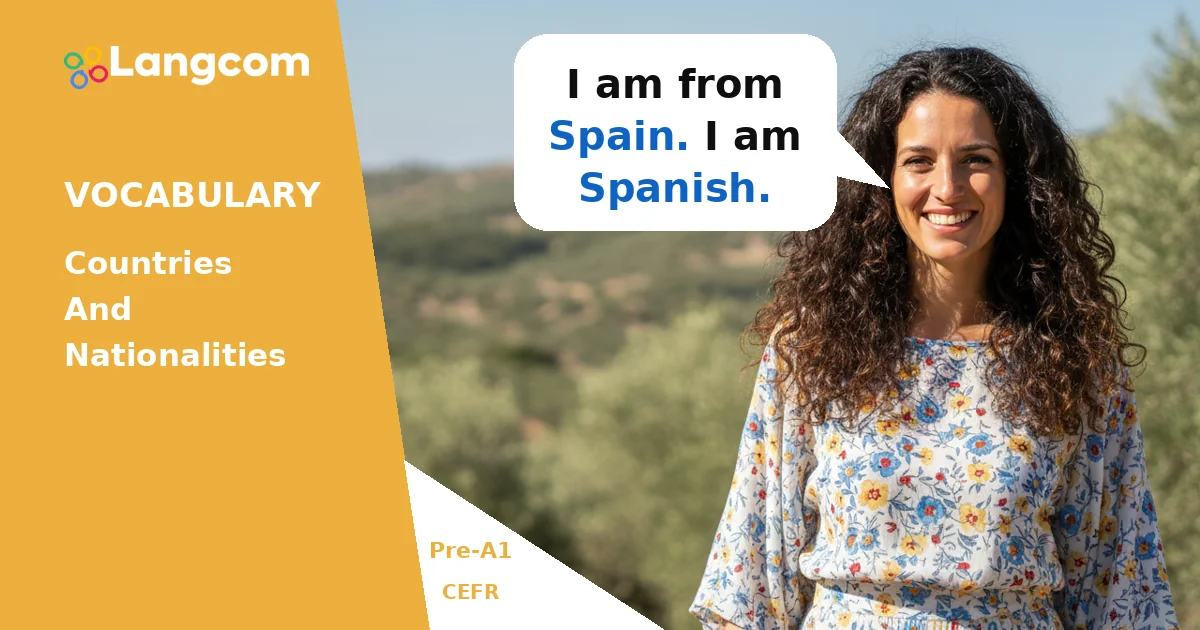

What Are Nationalities?
A nationality tells us the country a person is from. It is an adjective. It describes a person or a thing.
- He is from Italy. He is Italian.
- She is from China. She is Chinese.
We use nationalities to talk about people, food, music, and many other things.
🎓 Impara l'inglese con il metodo misto
Piccoli gruppi · Tutor IA disponibile 24 ore su 24, 7 giorni su 7 · Preparazione agli esami di Cambridge
Piani da $39 $79 al mese
How Do We Form Nationalities?
Many nationalities follow common patterns. You can often guess the nationality from the country name.
- -ish: For countries like Poland → Polish, Turkey → Turkish, the UK → British.
- -an / -ian: For countries like America → American, Italy → Italian, Russia → Russian, Australia → Australian.
- -ese: For countries like China → Chinese, Japan → Japanese.
- -ch / -sh: For countries like France → French, Spain → Spanish.
Some nationalities are irregular, but these patterns are a good start.
Important Rule: Capital Letters!
In English, all nationalities always start with a capital letter. This is very important.
- I am Spanish. (NON I am spanish.)
- He is American. (NON He is american.)
- This is Japanese food. (NON This is japanese food.)
Using Nationalities in Sentences
You can use nationalities in simple sentences to describe people or things.
- To say where someone is from: I am from Mexico. I am Mexican.
- To describe a person: She is a British singer.
- To describe an object: This is an Italian car.
| Country | Nationality |
|---|---|
| Spain | Spanish |
| The UK | British |
| USA | American |
| Italy | Italian |
| China | Chinese |
| Japan | Japanese |
| Mexico | Mexican |
| Germany | German |
| France | French |
| Poland | Polish |
| Australia | Australian |
| Turkey | Turkish |
Esempi
- I am from Spain. I am Spanish.
- He is from the UK. He is British.
- She is from the USA. She is American.
- We are from Poland. We are Polish.
- They are from Japan. They are Japanese.
- This is a Chinese restaurant.
Esercitazione
💬 Hai bisogno di una consulenza personalizzata?
In qualità di Centro autorizzato di preparazione agli esami Cambridge, possiamo aiutarti a scegliere il corso e la certificazione più adatti alle tue esigenze. Contatta oggi stesso i nostri consulenti.
Chatta con un consulente su WhatsAppErrori comuni per chi parla spagnolo
Not Using Capital Letters
In Spanish, nationalities do not always start with a capital letter. In English, they always do!
- Correct: I am Italian.
- Incorrect: I am italian.
Using ‘from’ or ‘of’ with the Nationality
You say ‘I am from [country]’, but ‘I am [nationality]’. Do not use ‘from’ or ‘of’ with the nationality itself.
- Correct: She is Russian.
- Incorrect: She is from Russian.
- Incorrect: She is of Russia.
Adding ‘person’ unnecessarily
Often, you just need the nationality adjective, not ‘person’ after it.
- Correct: He is French.
- Less natural: He is a French person.
Domande frequenti
Do nationalities always start with a capital letter in English?
Yes, always! For example, Spanish, American, Chinese.
Can I use a nationality to describe a thing, not just a person?
Yes, you can. For example, you can say Japanese food, British music, oppure Italian shoes.
Is ‘American’ a country or a nationality?
American is a nationality. The country is the USA oppure the United States.




0 Commenti