

What are the main rooms in a house?
A house usually has several important rooms. Each room has a different purpose.
- Les bedroom is where you sleep.
- Les bathroom is where you wash.
- Les kitchen is where you cook food.
- Les living room is where you relax, watch TV, or spend time with family.
- Les dining room is where you eat meals, especially dinner.
- A garden is an area outside the house with plants and flowers.
🎓 Apprenez l'anglais grâce à la méthode mixte
Petits groupes · Tuteur IA disponible 24 h/24, 7 j/7 · Préparation aux examens de Cambridge
Plans provenant de $39 $79 par mois
What can you find in each room?
Inside each room, there are many objects. Here are some common ones:
- In the bedroom, you can find a bed, a lamp, and sometimes a mirror.
- In the bathroom, there is usually a shower, a toilet, and a mirror.
- In the kitchen, you will see an oven, a table, et chairs.
- In the living room, there is often a sofa, a TV, and a picture on the wall.
- In the dining room, you will find a table et chairs.
How do we talk about rooms and objects?
We use simple words to say where things are. The word in means ‘inside’.
- To say something exists, we use There is (for one thing) or There are (for many things).
- For example: There is a bed in the bedroom.
- Or: There are two chairs in the kitchen.
- You can also say: The sofa is in the living room.
| Room | Common Objects |
|---|---|
| Bedroom | bed, lamp, mirror |
| Bathroom | shower, toilet, mirror |
| Kitchen | oven, table, chairs |
| Living Room | sofa, TV, picture |
| Dining Room | table, chairs |
| Garden | plants, flowers |
Exemples
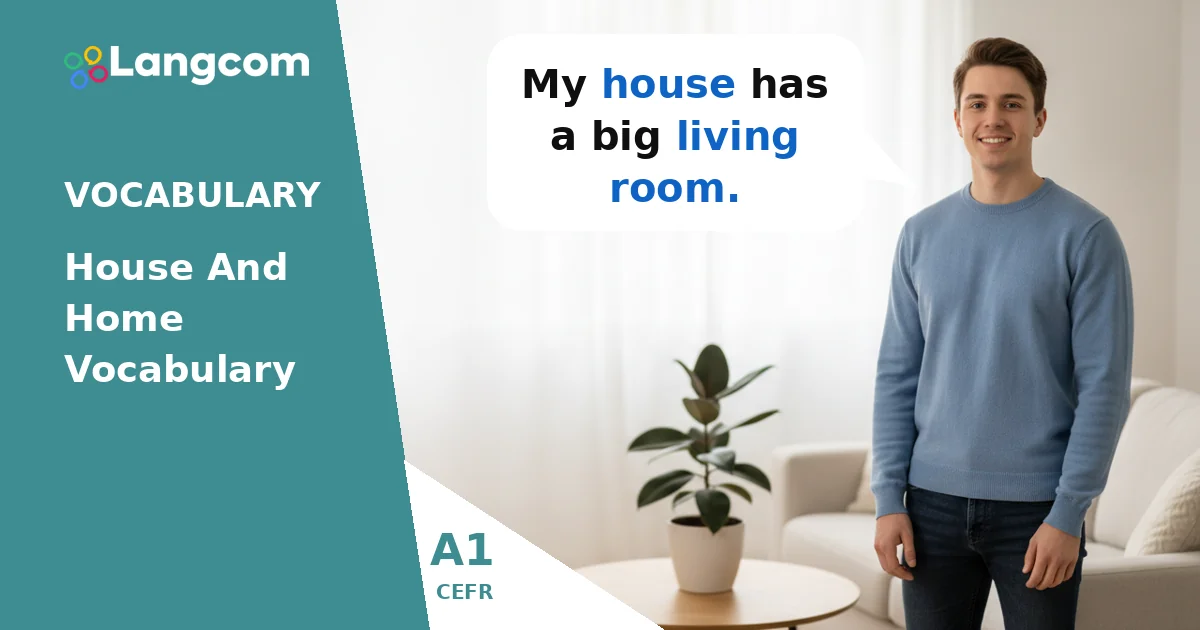
- My house has a big living room.
- There is an oven in the kitchen.
- I sleep in my bedroom.
- The bathroom has a shower.
- We eat dinner in the dining room.
- There is a small garden outside.
Entraînement
💬 Vous avez besoin de conseils personnalisés ?
En tant que centre de préparation agréé par Cambridge, nous pouvons vous aider à choisir la formation et la certification qui vous conviennent. Discutez-en dès aujourd'hui avec nos conseillers.
Discutez avec un conseiller sur WhatsAppErreurs courantes chez les hispanophones
‘House’ vs. ‘Home’
Spanish speakers sometimes confuse house et home. They are similar but not the same:
- A house is a building. It is a physical structure. My house is big.
- A home is the place where you live, and it often has emotional meaning. It can be a house, an apartment, or any place you feel comfortable. I go home after work. (You don’t say ‘I go house after work’).
Questions fréquemment posées
What is the difference between a ‘house’ and an ‘apartment’?
A house is usually a separate building. An apartment is a part of a larger building, like a flat, where many people live.
Can I say ‘my home’ or ‘my house’?
Yes, you can say my home ou my house. My house refers to the building. My home refers to the place where you live and feel comfortable.
What is a ‘living room’ for?
Les living room is a common room in a house or apartment where people relax, watch TV, read, or spend time with family and friends. It’s often the main social area.



0 commentaire