

What are singular and plural nouns?
A singular noun means one person, one animal, one place, or one thing.
- Example: a dog, a book, a city.
A plural noun means more than one person, animal, place, or thing.
- Example: dogs, books, cities.
We use plural nouns to talk about many things.
🎓 Apprenez l'anglais grâce à la méthode mixte
Petits groupes · Tuteur IA disponible 24 h/24, 7 j/7 · Préparation aux examens de Cambridge
Plans provenant de $39 $79 par mois
How do we make most nouns plural?
For most nouns, we add -s at the end. This is the most common rule.
Look at these examples:
- one cat → two cats
- one car → two cars
- one table → two tables
- one friend → two friends
When do we add -es to make nouns plural?
If a noun ends with -s, -ss, -sh, -ch, -x, ou -z, we add -es.
This makes the word easier to say.
Here are some examples:
- one bus → two buses
- one class → two classes
- one dish → two dishes
- one watch → two watches
- one box → two boxes
- one quiz → two quizzes
What about nouns ending in -y?
If a noun ends in -y and has a consonant before it (like b, c, d, f, g, h, j, k, l, m, n, p, q, r, s, t, v, w, x, z), we change the -y to -i and add -es.
Examples:
- one baby → two babies (consonant ‘b’ before ‘y’)
- one city → two cities (consonant ‘t’ before ‘y’)
- one party → two parties (consonant ‘t’ before ‘y’)
Important: If a noun ends in -y but has a vowel before it (like a, e, i, o, u), we just add -s.
- one day → two days (vowel ‘a’ before ‘y’)
- one boy → two boys (vowel ‘o’ before ‘y’)
Are there any special plural nouns?
Yes, some nouns have different plural forms. They do not follow the -s ou -es rules. These are called irregular plurals.
You need to learn them by heart.
Here are a few common ones for beginners:
- one man → two men
- one woman → two women
- one child → two children
- one foot → two feet
- one tooth → two teeth
- one mouse → two mice
| Rule | Singular Example | Plural Example |
|---|---|---|
| Add -s | dog | dogs |
| Add -es (for -s, -ss, -sh, -ch, -x, -z) | bus | buses |
| Change -y to -ies (after consonant) | baby | babies |
| Add -s (after vowel + -y) | boy | boys |
| Irregular | man | men |
Exemples
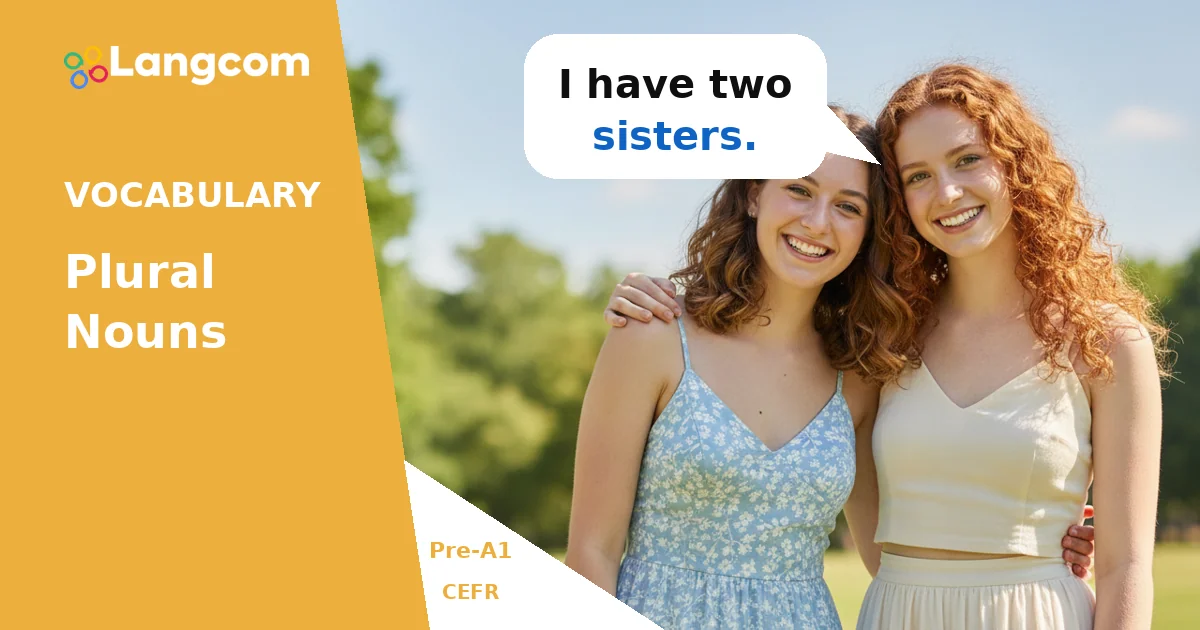
- I have two sisters.
- There are many buses in the city.
- She has three watches.
- The babies are sleeping.
- My friend has two dogs and three cats.
- We saw many children in the park.
- The boxes are empty.
Entraînement
💬 Vous avez besoin de conseils personnalisés ?
En tant que centre de préparation agréé par Cambridge, nous pouvons vous aider à choisir la formation et la certification qui vous conviennent. Discutez-en dès aujourd'hui avec nos conseillers.
Discutez avec un conseiller sur WhatsAppErreurs courantes chez les hispanophones
Forgetting to add -s/-es: Spanish speakers might forget to add -s ou -es because in Spanish, the plural is often formed differently or implied by the article.
- Wrong: I have two car.
- Right: I have two cars.
Adding -es incorrectly: Sometimes learners add -es when only -s is needed, or vice-versa.
- Wrong: two watchs
- Right: two watches
Not changing -y to -ies: Forgetting to change -y to -i before adding -es for words like city.
- Wrong: many citys
- Right: many cities
Using singular for irregular plurals: Using the singular form when a plural is needed for irregular nouns.
- Wrong: two child
- Right: two children
Questions fréquemment posées
What is the most common way to make a noun plural?
The most common way is to add -s to the end of the singular noun. For example, book becomes books.
Do all nouns follow the same rules for plurals?
No, most nouns follow rules like adding -s ou -es. But some nouns have irregular plural forms, like man becoming men.
How do I know if I should add -s or -es?
You add -es if the noun ends in -s, -ss, -sh, -ch, -x, ou -z. For all other common endings, you usually add -s.




0 commentaire