

Why Are Advanced Thought Process Verbs Important?
Using precise vocabulary shows a higher level of English proficiency. At C1 level, you need to express subtle differences in meaning.
- These verbs help you describe exactly how someone thinks, rather than just that they are thinking.
- They are essential for academic discussions, business meetings, and expressing opinions clearly.
- They allow you to communicate complex ideas with accuracy and sophistication.
✍️ Not sure which level you are?
Passez notre test de niveau gratuit et recevez des commentaires personnalisés de la part d'examinateurs certifiés par Cambridge.
Passez notre test de niveau GRATUITVerbs for Understanding and Examining
These verbs describe how we look at information or situations to understand them better.
- Analyze: To study or examine something carefully to learn more about it. The scientists analyzed the data to find patterns.
- Interpret: To examine something in order to explain its meaning. It’s difficult to interpret these ancient symbols.
- Evaluate: To consider or study the quality, importance, amount, or value of something. We need to evaluate the risks before making a decision.
Verbs for Deciding and Reacting
These words describe how we react to ideas, suggestions, or decisions.
- Dismiss: To refuse to consider an idea or opinion. She dismissed his concerns as unimportant.
- Disregard: To not allow something to influence you; to ignore. Please disregard the previous email.
- Reject: To refuse to accept or agree with something, like an alternative scenario or suggestion. The committee rejected the proposal.
- Reconsider: To think again about a decision or an opinion and decide whether you want to change it. He asked me to reconsider my offer.
Verbs for Anticipating and Assuming
These verbs relate to thinking about the future or forming an opinion based on limited information.
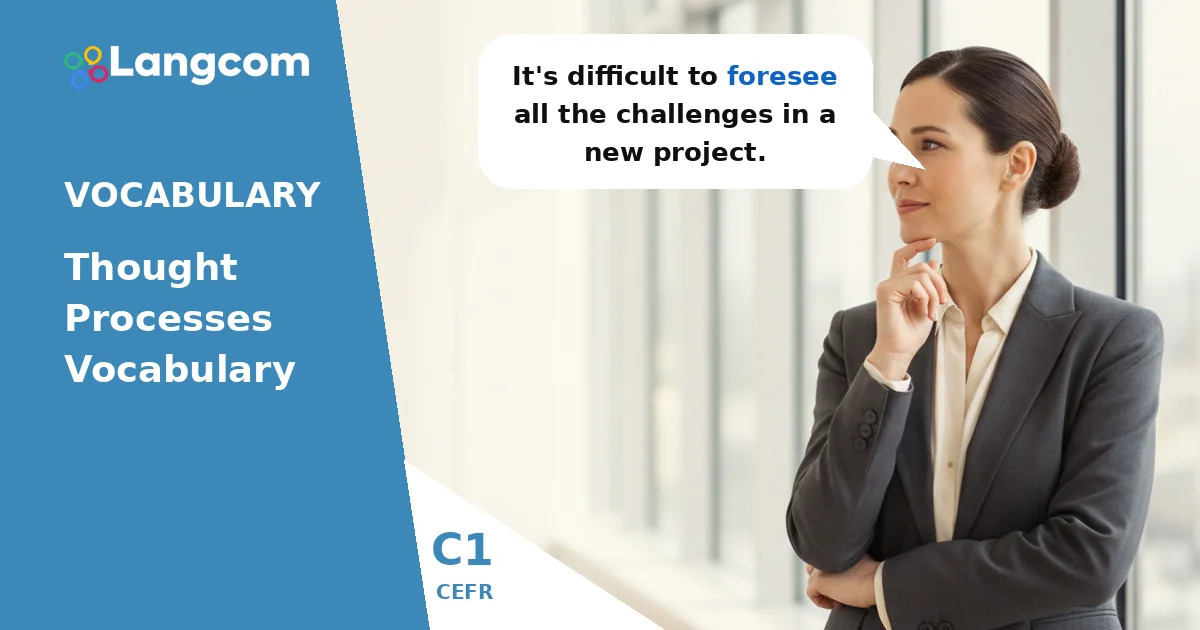
- Foresee: To imagine or expect a future situation or event before it happens. Nobody could foresee the sudden change in the market.
- Presume: To think that something is true, but with uncertainty. I presume you’re coming to the meeting, right?
Verbs for Intense Focus
This verb describes a strong, sometimes excessive, focus on one thing.
- Fixate: To think about something too much and find it difficult to stop. He tends to fixate on small details.
| Verb | Meaning |
|---|---|
| analyze | To study something carefully to understand it. |
| dismiss | To refuse to consider an idea or opinion. |
| disregard | To ignore something or not let it influence you. |
| evaluate | To judge the quality, importance, or value of something. |
| fixate | To think about something too much and cannot stop. |
| foresee | To know or expect something before it happens. |
| interpret | To explain the meaning of something. |
| presume | To believe something is true without certain proof, but with good reason. |
| reconsider | To think about a decision or opinion again to change it. |
| reject | To refuse to accept or agree with something. |
Exemples
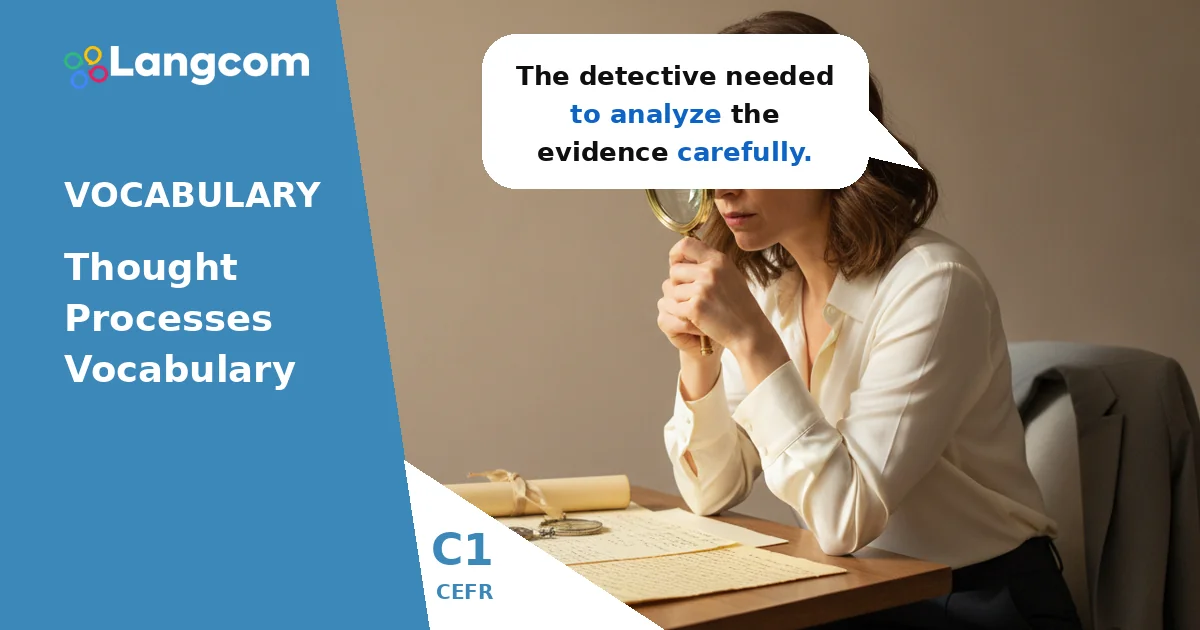
- The detective needed to analyze the evidence carefully.
- She chose to dismiss his rude comments and continue her work.
- It’s important not to disregard the advice of experts.
- Before buying, you should evaluate the car’s condition.
- Some people fixate on past mistakes instead of moving forward.
- It’s hard to foresee the long-term consequences of this decision.
- Can you interpret the meaning of this poem?
- I presume you have already finished the report.
- After hearing new information, she decided to reconsider her plans.
- The editor decided to reject the article due to its poor quality.
Entraînement
Ready to earn your certificate?
Langcom prepares students for Cambridge, IELTS, TOEFL, DELE, SIELE and Michigan exams.
Get started with LangcomErreurs courantes chez les hispanophones
Confusing Presume et Assume
Spanish speakers sometimes confuse presume with assume. While both mean to believe something without proof, presume often implies a reasonable belief based on probability or past experience, even if not certain. Assume can be a more general guess, sometimes without much basis.
- Correct : I presume you’re tired after your long journey. (It’s a reasonable expectation.)
- Less precise: I assume you’re tired after your long journey. (Possible, but presume fits better if there’s a strong reason.)
Overusing Basic Verbs
At C1 level, avoid using basic verbs like think about when a more specific verb exists. For example:
- Instead of: I need to think about the situation carefully.
- Use: I need to analyze the situation carefully.
- Instead of: They thought the idea was bad.
- Use: They dismissed the idea. ou They rejected the idea.
Questions fréquemment posées
What does C1 level mean for vocabulary?
C1 (Advanced) level means you can understand and use a wide range of demanding, longer texts, and recognize implicit meaning. For vocabulary, it means using precise, nuanced words like analyze ou foresee to express complex ideas effectively in academic and professional contexts.
How do these verbs improve my English communication?
These verbs allow you to express the exact nature of a thought process, rather than just a general idea. This makes your communication more precise, sophisticated, and impactful. For example, knowing the difference between dismiss et reject helps you convey subtle differences in how an idea is handled.
What is the difference between dismiss et reject?
Dismiss means to refuse to consider an idea or opinion, often implying it’s not worth serious thought. Reject means to refuse to accept or agree with something, often after consideration. You might dismiss a silly suggestion, but reject a job offer after careful thought.
Can I use these verbs in everyday conversation?
Yes, absolutely! While these verbs are common in formal contexts, they can also make your everyday conversations more articulate. For example, saying I need to reconsider my plans sounds more natural and precise than I need to think about my plans again.


0 commentaire