

What are ‘Some’ and ‘Any’?
Some y any are words that help us talk about quantities. They are used when we don’t know the exact number or amount of something, or when it’s not important to say the exact number.
They can be used with both countable nouns (things you can count, like ‘apples’, ‘books’) and uncountable nouns (things you cannot count, like ‘water’, ‘information’).
✍️ ¿No sabes en qué nivel estás?
Realiza nuestra prueba de nivel gratuita y recibe comentarios personalizados de examinadores certificados por Cambridge.
Realice nuestra prueba de nivel GRATUITAWhen Do We Use 'Some'?
We mostly use some in positive, or affirmative, sentences.
- Affirmative Sentences: When you say something is true or exists.
Ejemplo: I have some good news for you. - Offers: When you ask someone if they want something.
Ejemplo: Would you like some coffee? - Requests: When you ask for something.
Ejemplo: Can I have some water, please?
When Do We Use 'Any'?
We mostly use any in negative sentences and most questions.
- Negative Sentences: When you say something is not true or does not exist. We often use any after 'not'.
Ejemplo: I don't have any brothers or sisters. - Questions: When you ask if something exists or is true.
Ejemplo: Do you have any questions? - With 'Hardly', 'Scarcely', 'Barely': These words have a negative meaning, so we use any.
Ejemplo: There's hardly any food left.
Countable and Uncountable Nouns with 'Some' and 'Any'
The rules for some y any are the same for both countable and uncountable nouns.
- Countable Nouns: These are things you can count (e.g., 'apples', 'chairs'). Use some o any with their plural forms.
Example (affirmative): She bought some new clothes.
Example (negative): We didn't see any interesting movies. - Uncountable Nouns: These are things you cannot count individually (e.g., 'water', 'information', 'money'). Use some o any with them.
Example (affirmative): I need some advice.
Example (negative): There isn't any milk in the fridge.
| Situation | <span data-no-translation>Some</span> | <span data-no-translation>Any</span> |
|---|---|---|
| Affirmative Sentences | I have some friends. | — |
| Negative Sentences | — | I don't have any friends. |
| General Questions | — | Do you have any questions? |
| Offers | Would you like some coffee? | — |
| Requests | Can I have some water? | — |
Ejemplos
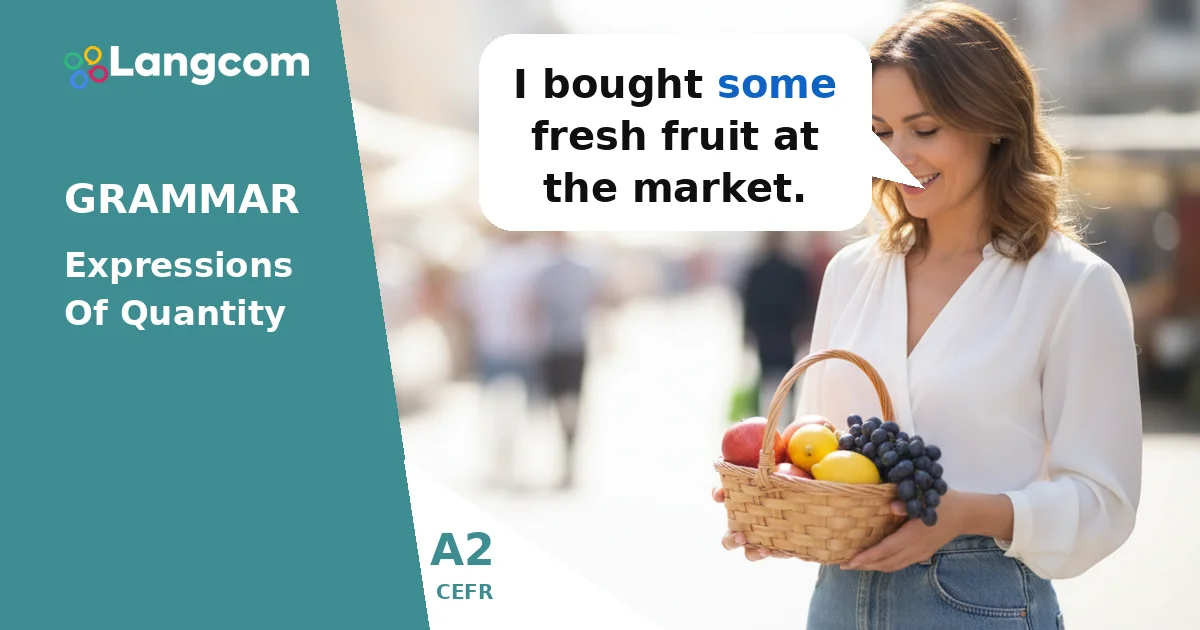
- I bought some fresh fruit at the market.
- Do you have any plans for the weekend?
- She doesn't want any help with her homework.
- Would you like some more tea?
- Can I borrow some money, please?
- There aren't any tickets left for the concert.
- He needs some time to think about it.
- Is there any sugar in this coffee?
Práctica
¿Estás listo para obtener tu certificado?
El curso Langcom prepara a los alumnos para los exámenes de Cambridge, IELTS, TOEFL, DELE, SIELE y Michigan.
Empieza a utilizar LangcomErrores habituales de los hispanohablantes
Spanish speakers sometimes make mistakes with some y any because Spanish uses similar words differently.
- Uso de some in negative sentences: In Spanish, you might use 'algún/alguna' in a negative way, but in English, you must use any.
Incorrecto: I don't have some money.
Correcto: I don't have any money. - Uso de any in affirmative sentences (unless it means 'it doesn't matter which'):
Incorrecto: I want any water.
Correcto: I want some water. (Unless you mean 'I want water, it doesn't matter what kind', which is less common.) - Confusing 'no' with 'not any': No can be used directly before a noun, but any needs a negative verb.
Correcto: I have no problems. (Meaning: I don't have any problems.)
Preguntas más frecuentes
What is the main difference between 'some' and 'any'?
The main difference is that some is generally used in affirmative sentences, offers, and requests, while any is used in negative sentences and most questions.
Can I use 'some' in questions?
Yes, you can use some in questions, but only when you are making an offer (e.g., Would you like some cake?) or a request (e.g., Could I have some help?). In general questions, we use any.
Do 'some' and 'any' change for countable or uncountable nouns?
No, the rules for using some y any are the same for both countable nouns (e.g., some books, any chairs) and uncountable nouns (e.g., some water, any information).
How might 'some' and 'any' appear in the A2 Key exam?
In the A2 Key exam, you might see some y any in Reading and Writing Part 5, where you choose the correct word to complete gaps in a text. You need to understand the context (affirmative, negative, question, offer/request) to select the right option.


0 Comentarios