
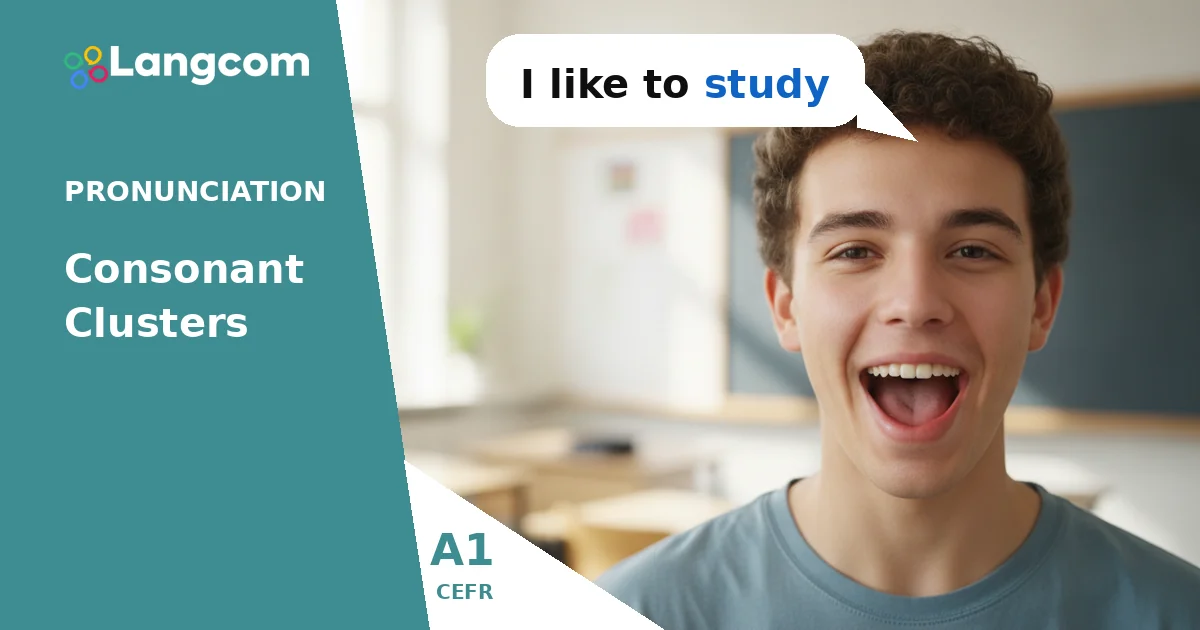

What Are Consonant Clusters?
A consonant cluster is when two or more consonant sounds appear together in a word without any vowel sound separating them.
For example, in the word stop, the letters s y t make two distinct consonant sounds together: /s/ and /t/. This is a consonant cluster.
- They can be at the beginning of a word: star, tree.
- They can be at the end of a word: hand, film.
- Sometimes, they can be in the middle of a word: monster.
🎓 Aprende inglés con el método mixto
Grupos reducidos · Tutor de IA disponible las 24 horas del día, los 7 días de la semana · Preparación para los exámenes de Cambridge
Planes de $39 $79 al mes
Why Are Consonant Clusters Important for A1 English?
Learning to pronounce consonant clusters correctly is a key step for A1 English learners.
- Clear Communication: When you pronounce clusters clearly, native speakers understand you better.
- Sounding Natural: Correct pronunciation helps you sound more like a native speaker.
- Listening Skills: Recognizing clusters helps you hear and understand English words more easily.
- Avoiding Mistakes: Many words have different meanings with different sounds. For example, sport y port are different words.
Common Consonant Clusters in English
There are many consonant clusters in English. Here are some common ones you will hear and use often at the A1 level:
- Beginning of words:
- st as in stop
- sp as in speak
- sk as in sky
- tr as in train
- dr as in drink
- End of words:
- nd as in hand
- nt as in want
- mp as in jamp
- nk as in think
- lt as in belt
- sk as in ask
- ns as in danse
- ks as in box (the ‘x’ often makes a /ks/ sound)
Tips for Spanish Speakers
English consonant clusters can be tricky for Spanish speakers because Spanish often adds a vowel sound before certain consonant groups.
- No ‘e’ before ‘s’ + consonant: In Spanish, words like ‘estudiar’ start with ‘es’. In English, you must NOT add an ‘e’ sound before clusters like st, sp, o sk.
- Say stop, not estop.
- Say sport, not esport.
- Pronounce ALL sounds: Make sure you say every consonant sound in the cluster. For example, in hand, make sure you hear both the /n/ and the /d/ sounds.
- Slow down: When you practice, say words with clusters slowly. This helps your mouth and tongue get used to the new movements.
How to Practice Consonant Clusters
Regular practice will help you master these sounds.
- Listen carefully: Pay attention to how native speakers pronounce words with clusters. Listen to English songs, movies, or podcasts.
- Repeat after a model: Find audio examples and try to imitate the pronunciation exactly.
- Record yourself: Use your phone to record your voice. Then, listen and compare it to a native speaker’s pronunciation.
- Focus on minimal pairs: Practice words that are very similar but differ by one sound or a cluster, like sport vs. port.
| Beginning of Word | End of Word |
|---|---|
| st (stop) | nd (hand) |
| sp (sport) | nt (want) |
| sk (sky) | mp (jump) |
| tr (train) | nk (think) |
| dr (drink) | lt (belt) |
| pl (play) | sk (ask) |
| bl (blue) | ns (dance) |
| ks (box) |
Ejemplos
- I like to study English.
- He has a big hand.
- Can I ask a question?
- I want a glass of water.
- They dance very well.
- I often think about my family.
- Please drink your milk.
- My belt is brown.
- This is a big box.
Práctica
💬 ¿Necesitas asesoramiento personalizado?
Como centro autorizado de preparación para los exámenes de Cambridge, podemos orientarte para que elijas el curso y la certificación más adecuados. Habla hoy mismo con nuestros asesores.
Chatea con un asesor por WhatsAppErrores habituales de los hispanohablantes
A very common mistake for Spanish speakers is adding an ‘e’ sound before initial ‘s’ clusters.
- Incorrecto: E-speak, E-stop, E-sky
- Correcto: Speak, Stop, Sky
Remember to start the sound directly with the ‘s’ sound, not with an ‘e’.
Preguntas más frecuentes
What is the difference between a consonant and a vowel?
A vowel sound is made with an open mouth, like a, e, i, o, u. A consonant sound is made by blocking or partly blocking air with your tongue, teeth, or lips, like p, t, s.
How many consonants can be in a cluster?
In English, consonant clusters can have two, three, or even four consonants. At A1, we usually focus on two-consonant clusters like st o nd.
Is it hard to pronounce consonant clusters?
It can be challenging at first, especially if your native language has different sound rules. But with practice, listening, and repeating, you will improve a lot. Many English words use these clusters.
Do all words with two consonants together have a cluster?
No, not always. For example, in the word singer, the ng makes one sound /ŋ/. In teacher, the ch makes one sound /tʃ/. A cluster means each consonant keeps its own sound.


0 Comentarios