
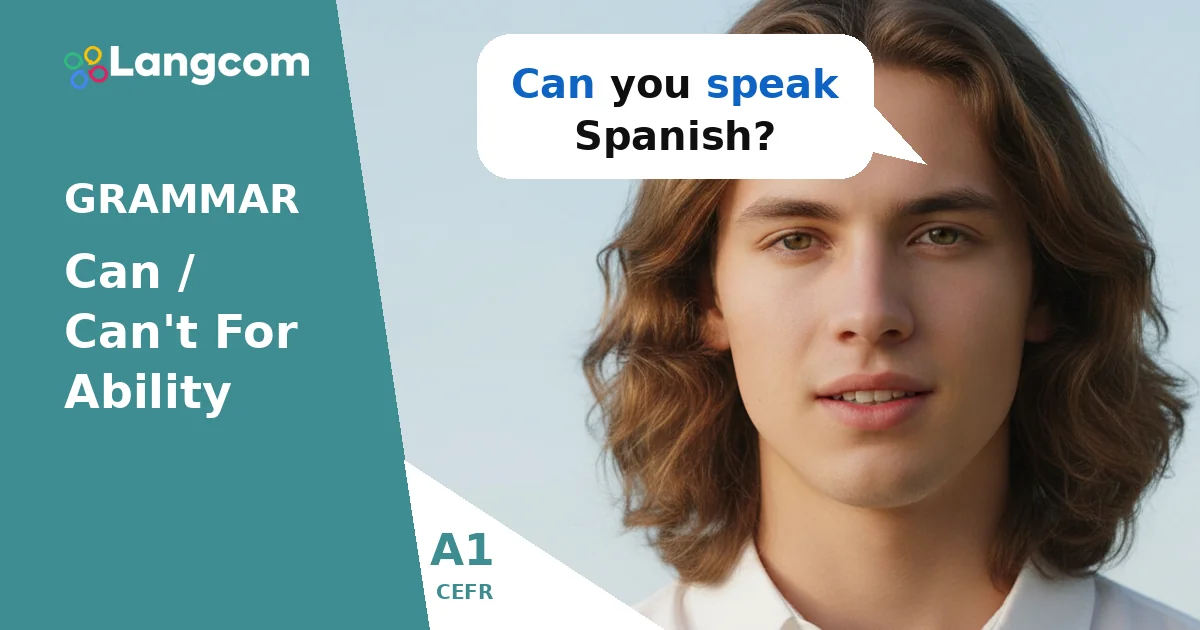

To ask about someone’s ability in English, we use Can at the beginning of the question. This word helps us talk about what people know how to do, like Can you swim? or Can she speak English? The structure is simple: Can + subject + base form of the verb. For example, Can he play the guitar?
When you answer these questions, you use short answers. For a positive answer, you say Yes, subject + can, such as Yes, I can. For a negative answer, you say No, subject + can’t, like No, they can’t. Remember, can’t is the short form of cannot. This makes it easy to talk about skills and talents in everyday conversations.
What Does ‘Can’ Mean in English?
Can is a special verb in English. We use it to talk about ability. Ability means what you know how to do or what you are able to do.
- For example, if you know how to cook, you can say, I can cook.
- If you are able to run fast, you can say, I can run fast.
🎓 Learn English with the Blended method
Small groups · 24/7 AI Tutor · Cambridge preparation
Plans from $39 $79 per month
How Do We Make Questions with ‘Can’?
To ask about someone’s ability, we change the word order. We put Can before the subject.
- First, start with Can.
- Next, add the subject (like you, he, she, they, it, we, or a name).
- Then, add the base form of the main verb (the verb without to or -ing).
- Finally, add any other information and a question mark.
The pattern is: Can + Subject + Base Verb + …?
How Do We Answer ‘Can’ Questions?
We usually give short answers to Can questions. This makes conversations quick and natural.
- Positive Answer: Use Yes, + subject + can.
- Negative Answer: Use No, + subject + can’t. (can’t is short for cannot)
| Yes/No Question | Positive Answer | Negative Answer |
|---|---|---|
| Can you swim? | Yes, I can. | No, I can’t. |
| Can she swim? | Yes, she can. | No, she can’t. |
| Can they swim? | Yes, they can. | No, they can’t. |
Examples
- Can you speak Spanish?
- Yes, I can.
- Can he play the piano?
- No, he can’t.
- Can she drive a car?
- Yes, she can.
- Can they cook Italian food?
- No, they can’t.
- Can we meet tomorrow?
- Yes, we can.
Practice
💬 Need personalized guidance?
As an Authorized Cambridge Preparation Centre, we can guide you to the right course and certification. Chat with our advisors today.
Chat with an Advisor on WhatsAppCommon mistakes for Spanish speakers
Spanish speakers sometimes make these mistakes:
- Incorrect word order: You might say You can swim? This is incorrect for a question. Remember to put Can first: Can you swim?
- Using only the main verb in short answers: You might say Yes, I swim. or No, I not swim. This is incorrect. Always use can or can’t in short answers: Yes, I can. or No, I can’t.
- Forgetting the base form: After can, always use the base form of the verb, without to or -ing. For example, Can you to sing? is wrong. It should be Can you sing?
Frequently asked questions
What is the difference between ‘can’ and ‘can’t’?
Can means you have the ability to do something. Can’t (or cannot) means you do not have the ability to do something. For example, I can swim but I can’t fly.
Do I need to change the verb after ‘can’?
No, you always use the base form of the verb after can. You do not add -s, -ed, or -ing. For example, Can she sing? (not sings or singing).
Can I use ‘can’ for other things besides ability?
Yes, can also expresses possibility or permission, but for A1 level, we focus on ability. For example, Can I go to the party? (permission) or It can be cold in winter. (possibility).


0 Comments