

How do we talk about the weather?
We often start sentences about the weather with It’s.
Then we add an adjective to describe the condition.
- It’s sunny. (The sun is shining.)
- It’s cloudy. (There are many clouds.)
- It’s rainy. (Rain is falling.)
- It’s windy. (There is a lot of wind.)
- It’s snowy. (Snow is falling.)
- It’s foggy. (There is a lot of fog, making it hard to see.)
✍️ Du bist dir nicht sicher, auf welchem Niveau du bist?
Machen Sie unseren kostenlosen Einstufungstest und erhalten Sie individuelles Feedback von zertifizierten Cambridge-Prüfern.
Machen Sie unseren KOSTENLOSEN EinstufungstestHow do we describe temperature?
We use adjectives to talk about how hot or cold it is.
Common words for temperature:
- hot (very warm)
- warm (a pleasant, high temperature)
- cool (a pleasant, low temperature)
- cold (a low temperature)
- freezing (extremely cold, water turns to ice)
To state the exact temperature, we say It’s + number + degrees Celsius (or Fahrenheit).
Beispiel: It’s 28 degrees Celsius today.
What about different types of precipitation?
Precipitation is water that falls from the sky.
We use verbs for these actions:
- It’s raining. (Water drops are falling.)
- It’s snowing. (Snowflakes are falling.)
- It’s hailing. (Small balls of ice are falling.)
You can also use adjectives for these:
- It’s rainy.
- It’s snowy.
- It’s stormy. (There is a lot of rain, wind, thunder, or lightning.)
Asking and Answering About the Weather
To ask about the current weather, use this question:
- What’s the weather like?
To answer, you can use the phrases we learned:
- It’s sunny and warm.
- It’s raining and cold.
- It’s very windy today.
| Noun | Adjektiv |
|---|---|
| sun | sunny |
| cloud | cloudy |
| rain | rainy |
| wind | windy |
| snow | snowy |
| fog | foggy |
| storm | stormy |
Beispiele
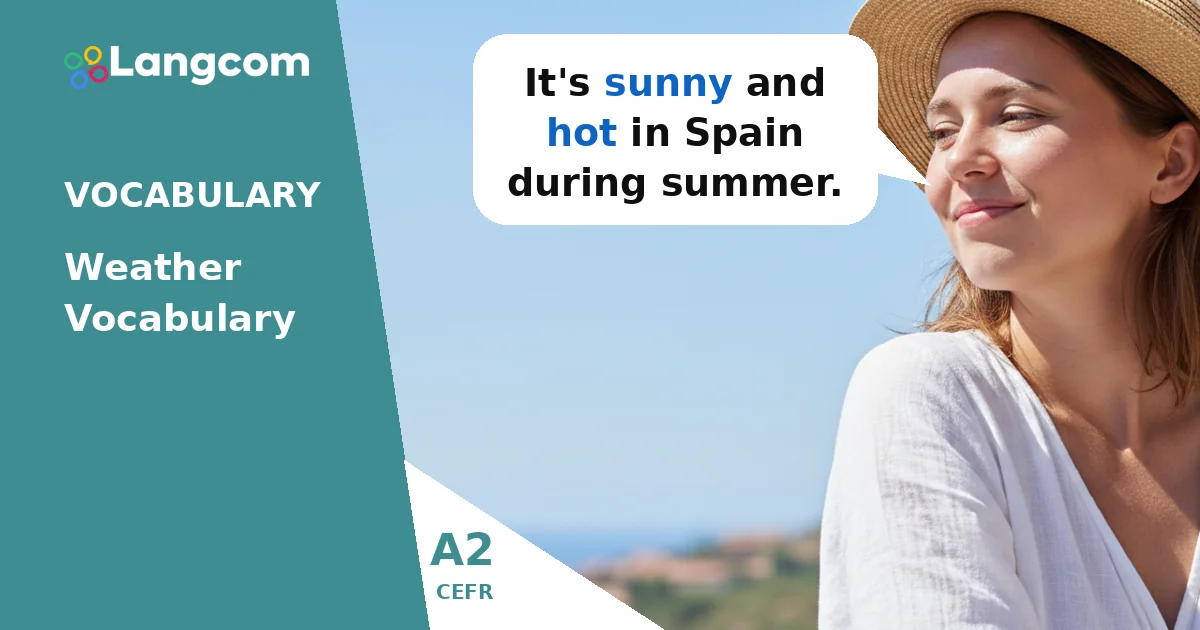
- It’s sunny and hot in Spain during summer.
- Tomorrow, it will be cloudy with a chance of rain.
- What’s the weather like in London? It’s often foggy.
- Be careful, it’s freezing outside!
- I love when it’s warm and not too windy.
- It’s snowing heavily in the mountains right now.
- The forecast says it will be 10 degrees Celsius tomorrow.
Übung
Bist du bereit, dein Zertifikat zu erwerben?
Der Kurs Langcom bereitet die Teilnehmer auf die Prüfungen von Cambridge, IELTS, TOEFL, DELE, SIELE und Michigan vor.
Erste Schritte mit LangcomHäufige Fehler bei Spanischsprechern
Spanish speakers sometimes translate “hace sol” or “hace frío” directly.
- Falsch: It makes sun. / It makes cold.
- Richtig: It’s sunny. / It’s cold.
Remember to use It’s + adjective for general weather descriptions.
Also, don’t forget the “it” when talking about rain or snow:
- Falsch: Is raining.
- Richtig: It’s raining.
Häufig gestellte Fragen
What is the difference between cloudy and overcast?
Cloudy means there are many clouds in the sky. Overcast means the sky is completely covered with clouds, often making it dark. Overcast suggests no sun at all.
How do I ask about the weather for a future day?
You can ask: What will the weather be like tomorrow? oder What’s the forecast for next week?
Why is weather vocabulary important for the A2 Key exam?
In the A2 Key (KET) exam, you might need to describe pictures, talk about daily life, or answer questions about your plans, which often include discussing the weather. For example, in Speaking Part 1, you might be asked What’s your favourite type of weather?
What does partly cloudy mean?
Partly cloudy means there are some clouds in the sky, but also some blue sky and sun. It’s not completely sunny, but not completely cloudy either.




0 Kommentare