

When do we use the Present Simple?
We use the Present Simple to talk about actions or situations that are always true, happen regularly, or are part of a fixed schedule.
- Permanent Situations and Facts: For things that are generally true and do not change. For example, scientific facts or general knowledge.
- Habits and Routines: For actions that you do regularly, every day, week, or year. We often use adverbs of frequency like always, often, oder never with this use.
- Time Clauses (Future Meaning): When we talk about the future after words like when, as soon as, until, before, after, und once.
- Zero Conditionals: To describe general truths or scientific facts where one event always leads to another.
- Instructions and Directions: In recipes, manuals, or when giving directions.
- Sports Commentary and Narratives: To describe events as they happen, making them sound more immediate.
✍️ Du bist dir nicht sicher, auf welchem Niveau du bist?
Machen Sie unseren kostenlosen Einstufungstest und erhalten Sie individuelles Feedback von zertifizierten Cambridge-Prüfern.
Machen Sie unseren KOSTENLOSEN EinstufungstestWhen do we use the Present Continuous?
Die Present Continuous describes actions that are happening at the moment of speaking, or around that time, and are often temporary.
- Actions Happening Now: For things that are in progress at this exact moment.
- Temporary Situations: For actions or situations that are not permanent and will change soon.
- Developing Situations: To describe changes or trends that are happening over a period of time. We often use words like getting oder becoming.
- Events in the Near Future: For definite plans or arrangements in the near future, especially with a specific time or date.
- Annoying Habits (with 'always'): To complain about something someone does too often.
What are Stative Verbs and why are they special?
Stative verbs describe states, feelings, opinions, or senses, rather than actions. They are usually not used in continuous tenses, even if the situation is temporary.
- Verbs of Opinion: believe, doubt, guess, imagine, know, mean, realise, recognise, remember, suppose, think (for opinion), understand.
- Verbs of Feeling: admire, dislike, hate, like, love, prefer, want, wish.
- Verbs of Possession: belong, have (for possession), own.
- Verbs of Senses: hear, see, smell, sound, taste.
- Other Stative Verbs: be, consist, fit, include, keep, seem.
Some stative verbs can be used in continuous forms when they describe an action or temporary behaviour, changing their meaning. For example, I think it's a good idea (opinion) vs. I'm thinking about my holidays (mental process).
| Feature | Present Simple | Present Continuous |
|---|---|---|
| Main Use | Facts, habits, permanent situations | Actions happening now, temporary situations, future plans |
| Keywords | Always, often, usually, every day, never | Now, at the moment, currently, this week, today, next week |
| Example (Habit) | She drinks coffee every morning. | N/A |
| Example (Now) | N/A | She is drinking coffee now. |
| Example (Fact) | Water boils at 100°C. | N/A |
| Example (Temporary) | N/A | He is working from home this month. |
| Stative Verbs | Used normally | Generally not used |
Beispiele
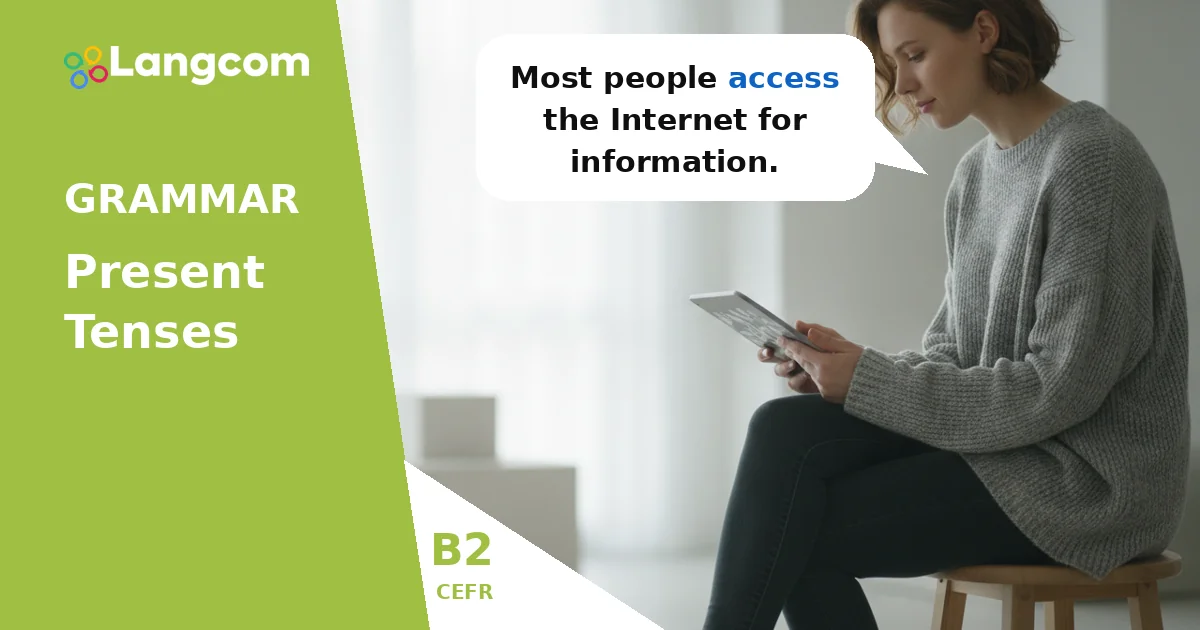
- Most people access the Internet for information.
- I check my emails twice a day.
- Once you finish your work, give me a ring.
- If you use all seven letters in the board game Scrabble, you get fifty extra points.
- Steam forms when water boils.
- I'm living at home until I move to campus.
- Traffic is becoming heavier and heavier.
- Sit still while I'm talking to you!
- Tom's leaving for Mexico next week.
- She keeps talking when I'm trying to watch TV.
- We wish we could be with you right now.
- The Earth revolves around the sun.
- Look! It's raining outside.
- My sister is always borrowing my clothes!
Übung
Bist du bereit, dein Zertifikat zu erwerben?
Der Kurs Langcom bereitet die Teilnehmer auf die Prüfungen von Cambridge, IELTS, TOEFL, DELE, SIELE und Michigan vor.
Erste Schritte mit LangcomHäufige Fehler bei Spanischsprechern
Spanish speakers often make specific mistakes with present tenses:
- Using Present Simple for actions happening now: In Spanish, the simple present can describe current actions. In English, this is incorrect.
✗ I eat now.
✓ I am eating now. - Using Present Continuous with stative verbs: Stative verbs describe states, not actions, so they usually don't take the continuous form.
✗ I am knowing the answer.
✓ I know the answer. - Confusing future uses: While both can refer to the future, the Present Simple is for fixed schedules or time clauses, and the Present Continuous is for personal arrangements.
✗ I go to the cinema tonight. (Unless it's a cinema schedule)
✓ I am going to the cinema tonight. (Personal arrangement)
Häufig gestellte Fragen
What is the main difference between Present Simple and Present Continuous?
Die Present Simple is for general truths, habits, and permanent situations. The Present Continuous is for temporary actions happening now, around now, or definite future plans.
Can I use stative verbs in the continuous form?
Generally, no. Stative verbs describe states, not actions, so they are typically used in simple tenses. However, some stative verbs can have a continuous form when their meaning changes to describe an action or temporary behavior, for example, I am having lunch (action) versus I have a car (possession).
How are present tenses tested in the B2 First exam?
In the B2 First exam, present tenses are often tested in the 'Use of English' paper, particularly in 'Part 2: Open Cloze' or 'Part 3: Word Formation', where you might need to choose the correct tense of a verb. They also appear in 'Part 4: Key Word Transformation' and are crucial for accurate writing in 'Part 1: Essay' and 'Part 2: Article/Review/Email/Report'.
When do we use Present Simple for future events?
We use the Present Simple for future events when talking about fixed schedules, timetables, or programs. For example, The train leaves at 7 PM. We also use it in time clauses like I'll call you when I arrive.


0 Kommentare