
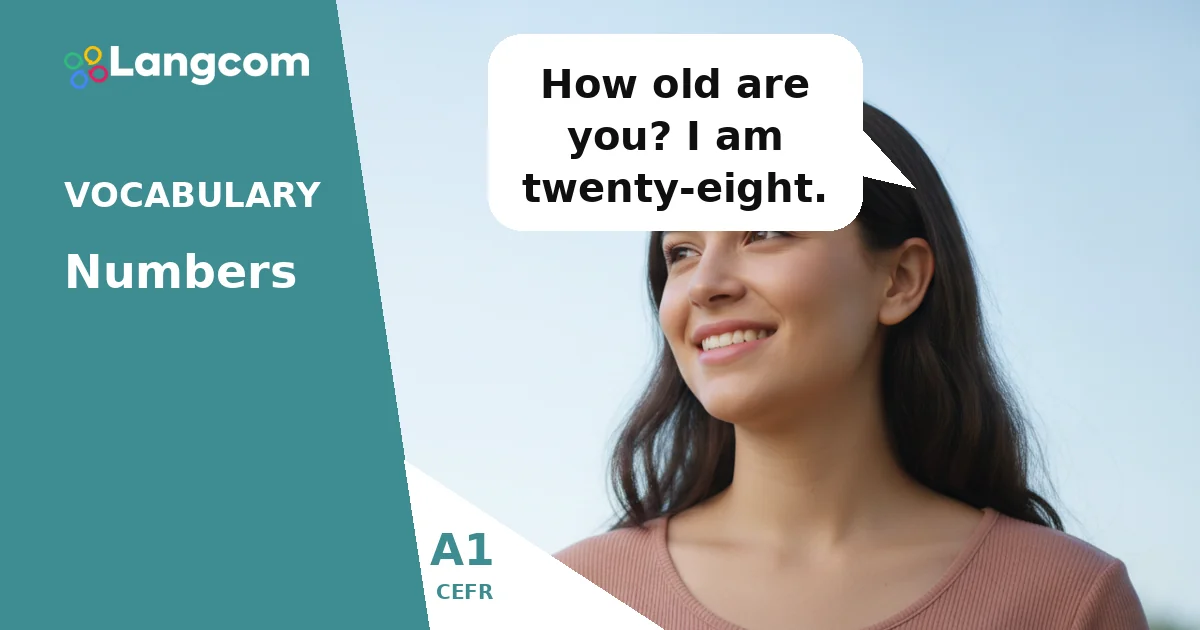

How Do You Ask Someone’s Age in English?
To ask about age in English, you use a special question phrase.
- Start your question with How old…?
- After How old, you need a form of the verb to be (am, is, or are).
- Then, add the person or people you are asking about.
🎓 Englisch lernen mit der Blended-Methode
Kleingruppen · KI-Tutor rund um die Uhr · Vorbereitung auf die Cambridge-Prüfungen
Pläne von $39 $79 pro Monat
How Do You Say Your Age in English?
When you say your age, you also use the verb to be. This is very important!
- The basic structure is: Subject + to be (am/is/are) + number + (years old).
- The words years old are optional. You can say I am 25 oder I am 25 years old. Both are correct.
- Remember to use the correct form of to be: I am, you are, he/she/it is, we are, they are.
What Numbers Are Important for Age?
To talk about age, you need to know numbers in English. For A1 level, focus on numbers up to 100.
- Here are some common numbers you will use:
- one, two, three, four, five, six, seven, eight, nine, ten
- eleven, twelve, thirteen, fourteen, fifteen, sixteen, seventeen, eighteen, nineteen
- twenty, thirty, forty, fifty, sixty, seventy, eighty, ninety, one hundred
| Zahl | Word |
|---|---|
| 1 | one |
| 5 | five |
| 10 | ten |
| 15 | fifteen |
| 20 | twenty |
| 25 | twenty-five |
| 30 | thirty |
| 40 | forty |
| 50 | fifty |
| 60 | sixty |
| 70 | seventy |
| 80 | eighty |
| 90 | ninety |
| 100 | one hundred |
Beispiele
- How old are you? I am twenty-eight.
- How old is your sister? She is nineteen years old.
- How old are your parents? They are sixty and sixty-two.
- My brother is thirty-five.
- My grandmother is eighty-seven years old.
Übung
💬 Benötigen Sie eine individuelle Beratung?
Als autorisiertes Cambridge-Vorbereitungszentrum können wir Ihnen helfen, den richtigen Kurs und die passende Zertifizierung zu finden. Chatten Sie noch heute mit unseren Beratern.
Chatten Sie mit einem Berater auf WhatsAppHäufige Fehler bei Spanischsprechern
A very common mistake for Spanish speakers is to use to have when talking about age. This is because in Spanish you say “tener… años” (to have… years). However, in English, we use to be.
- Falsch: I have thirty years old.
- Richtig: I am thirty years old.
- Falsch: How many years do you have?
- Richtig: How old are you?
Always remember to use to be (am, is, are) with age in English.
Häufig gestellte Fragen
Is it “years old” or just “years”?
You can say I am twenty-five oder I am twenty-five years old. Both are correct. You cannot say I am twenty-five years. The word old is important if you include years.
Why do I use “to be” and not “to have” for age?
In English, we describe age as a state of being, not something you possess. So, we use the verb to be (am, is, are). This is a key difference from Spanish, where you use “tener” (to have).
Do I need to know all the numbers?
For A1 level, focus on numbers up to 100, especially for common ages like 1-20 and then the tens (20, 30, 40, etc.). You will learn more numbers as you progress in English.

0 Kommentare