
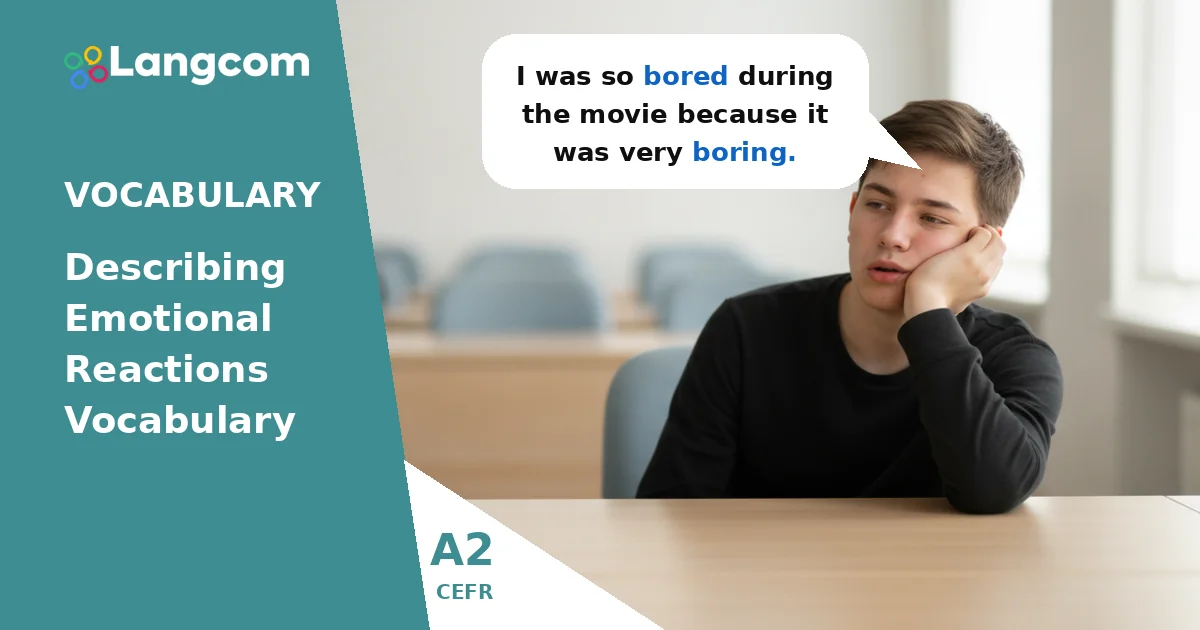

What are -ed adjectives for feelings?
We use adjectives ending in -ed to talk about how a person feels. These words describe an emotion that someone is experiencing.
Think of it as the person *receiving* the feeling.
- I am bored. (I have the feeling of boredom.)
- She is interested. (She has the feeling of interest.)
- He was tired. (He had the feeling of tiredness.)
- They felt excited. (They had the feeling of excitement.)
- We were surprised. (We had the feeling of surprise.)
✍️ Du bist dir nicht sicher, auf welchem Niveau du bist?
Machen Sie unseren kostenlosen Einstufungstest und erhalten Sie individuelles Feedback von zertifizierten Cambridge-Prüfern.
Machen Sie unseren KOSTENLOSEN EinstufungstestWhat are -ing adjectives for feelings?
We use adjectives ending in -ing to describe the thing, person, or situation that *causes* a feeling. These words tell us about the quality of something that makes us feel a certain way.
Think of it as the thing *giving* the feeling.
- The movie is boring. (The movie causes boredom.)
- The book is interesting. (The book causes interest.)
- The journey was tiring. (The journey caused tiredness.)
- The news was exciting. (The news caused excitement.)
- The ending was surprising. (The ending caused surprise.)
How can I remember the difference?
Here is a simple way to remember:
- Verwendung -ed for people and how they feel: I am bored.
- Verwendung -ing for things or situations that cause the feeling: The class is boring.
You can also think: I am -ed (describes me), It is -ing (describes it).
| Feeling (How you feel) | Cause (What causes the feeling) |
|---|---|
| bored | boring |
| interested | interesting |
| excited | exciting |
| tired | tiring |
| surprised | surprising |
| annoyed | annoying |
| frustrated | frustrating |
| confused | confusing |
| disappointed | disappointing |
Beispiele
- I was so bored during the movie because it was very boring.
- She was surprised by the surprising news about her trip.
- We felt excited about the exciting football match.
- The long journey was tiring, and I was very tired when I arrived.
- He finds history interesting; he is very interested in ancient cultures.
- Her constant complaining is annoying, and I feel very annoyed.
Übung
Bist du bereit, dein Zertifikat zu erwerben?
Der Kurs Langcom bereitet die Teilnehmer auf die Prüfungen von Cambridge, IELTS, TOEFL, DELE, SIELE und Michigan vor.
Erste Schritte mit LangcomHäufige Fehler bei Spanischsprechern
A common mistake for Spanish speakers is to translate directly from phrases like "Estoy aburrido." This can lead to saying I am boring when you mean I am bored.
- Falsch: I am boring. (This means *you* make other people feel bored.)
- Richtig: I am bored. (This means *you* feel boredom.)
Remember, if you are talking about your own feeling, use the -ed adjective.
Häufig gestellte Fragen
Can I use both -ed and -ing adjectives for people?
Yes, but the meaning changes completely. If you say He is bored, it means he feels the emotion of boredom. If you say He is boring, it means he makes other people feel bored.
Are there other adjectives like this?
Yes, many! Once you understand this rule, you will see it in many other pairs, such as confused/confusing, disappointed/disappointing, amazed/amazing, frustrated/frustrating, und annoyed/annoying.
How important is this for the A2 Key exam?
It is very important for clear communication! Using the correct form helps you express yourself accurately in the A2 Key Speaking and Writing parts. You might also need to understand these differences in Reading and Listening tasks.

0 Kommentare