
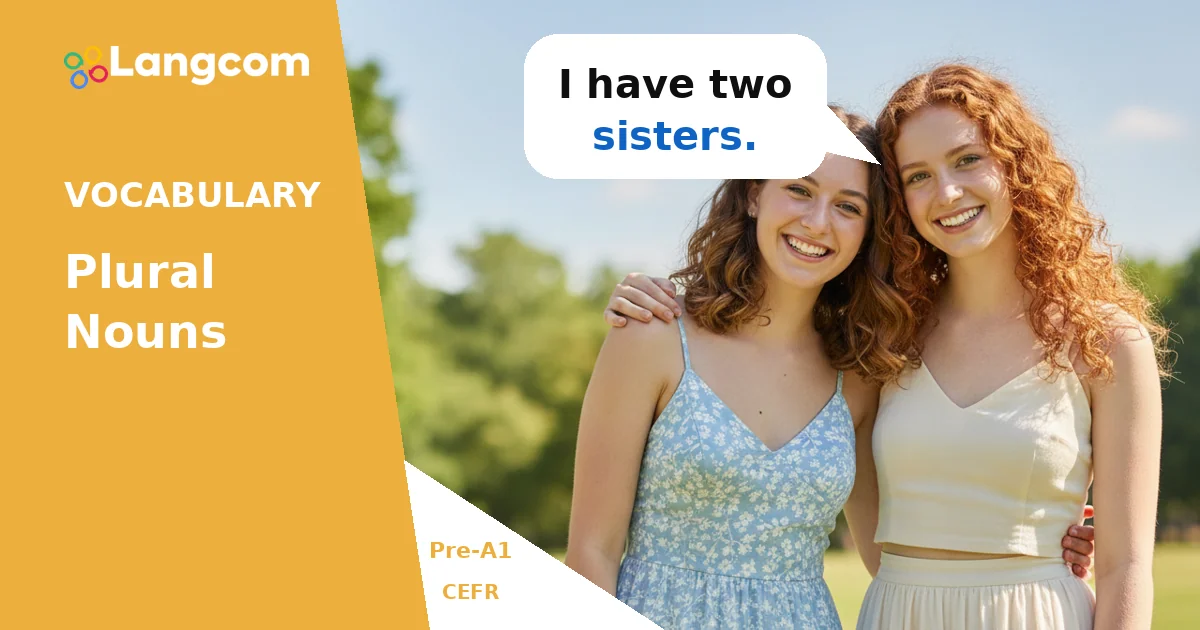

What are singular and plural nouns?
A singular noun means one person, one animal, one place, or one thing.
- Example: a dog, a book, a city.
A plural noun means more than one person, animal, place, or thing.
- Example: dogs, books, cities.
We use plural nouns to talk about many things.
🎓 تعلم اللغة الإنجليزية باستخدام الطريقة المختلطة
مجموعات صغيرة · مدرس ذكاء اصطناعي متاح على مدار الساعة · التحضير لامتحانات كامبريدج
خطط من $39 $79 في الشهر
How do we make most nouns plural?
For most nouns, we add -s at the end. This is the most common rule.
Look at these examples:
- one cat → two cats
- one car → two cars
- one table → two tables
- one friend → two friends
When do we add -es to make nouns plural?
If a noun ends with -s, -ss, -sh, -ch, -x, أو -z, we add -es.
This makes the word easier to say.
Here are some examples:
- one bus → two buses
- one class → two classes
- one dish → two dishes
- one watch → two watches
- one box → two boxes
- one quiz → two quizzes
What about nouns ending in -y?
If a noun ends in -y and has a consonant before it (like b, c, d, f, g, h, j, k, l, m, n, p, q, r, s, t, v, w, x, z), we change the -y to -i and add -es.
Examples:
- one baby → two babies (consonant ‘b’ before ‘y’)
- one city → two cities (consonant ‘t’ before ‘y’)
- one party → two parties (consonant ‘t’ before ‘y’)
Important: If a noun ends in -y but has a vowel before it (like a, e, i, o, u), we just add -s.
- one day → two days (vowel ‘a’ before ‘y’)
- one boy → two boys (vowel ‘o’ before ‘y’)
Are there any special plural nouns?
Yes, some nouns have different plural forms. They do not follow the -s أو -es rules. These are called irregular plurals.
You need to learn them by heart.
Here are a few common ones for beginners:
- one man → two men
- one woman → two women
- one child → two children
- one foot → two feet
- one tooth → two teeth
- one mouse → two mice
| Rule | Singular Example | Plural Example |
|---|---|---|
| Add -s | dog | dogs |
| Add -es (for -s, -ss, -sh, -ch, -x, -z) | bus | buses |
| Change -y to -ies (after consonant) | baby | babies |
| Add -s (after vowel + -y) | boy | boys |
| Irregular | man | men |
أمثلة
- I have two sisters.
- There are many buses in the city.
- She has three watches.
- The babies are sleeping.
- My friend has two dogs and three cats.
- We saw many children in the park.
- The boxes are empty.
التدريب
💬 هل تحتاج إلى إرشادات مخصصة؟
بصفتنا مركزًا معتمدًا للتحضير لاختبارات كامبريدج، يمكننا توجيهك نحو الدورة والشهادة المناسبتين لك. تحدث مع مستشارينا اليوم.
دردش مع مستشار على واتسابالأخطاء الشائعة لدى المتحدثين باللغة الإسبانية
Forgetting to add -s/-es: Spanish speakers might forget to add -s أو -es because in Spanish, the plural is often formed differently or implied by the article.
- Wrong: I have two car.
- Right: I have two cars.
Adding -es incorrectly: Sometimes learners add -es when only -s is needed, or vice-versa.
- Wrong: two watchs
- Right: two watches
Not changing -y to -ies: Forgetting to change -y to -i before adding -es for words like city.
- Wrong: many citys
- Right: many cities
Using singular for irregular plurals: Using the singular form when a plural is needed for irregular nouns.
- Wrong: two child
- Right: two children
الأسئلة الشائعة
What is the most common way to make a noun plural?
The most common way is to add -s to the end of the singular noun. For example, book becomes books.
Do all nouns follow the same rules for plurals?
No, most nouns follow rules like adding -s أو -es. But some nouns have irregular plural forms, like man becoming men.
How do I know if I should add -s or -es?
You add -es if the noun ends in -s, -ss, -sh, -ch, -x, أو -z. For all other common endings, you usually add -s.



0 تعليق