
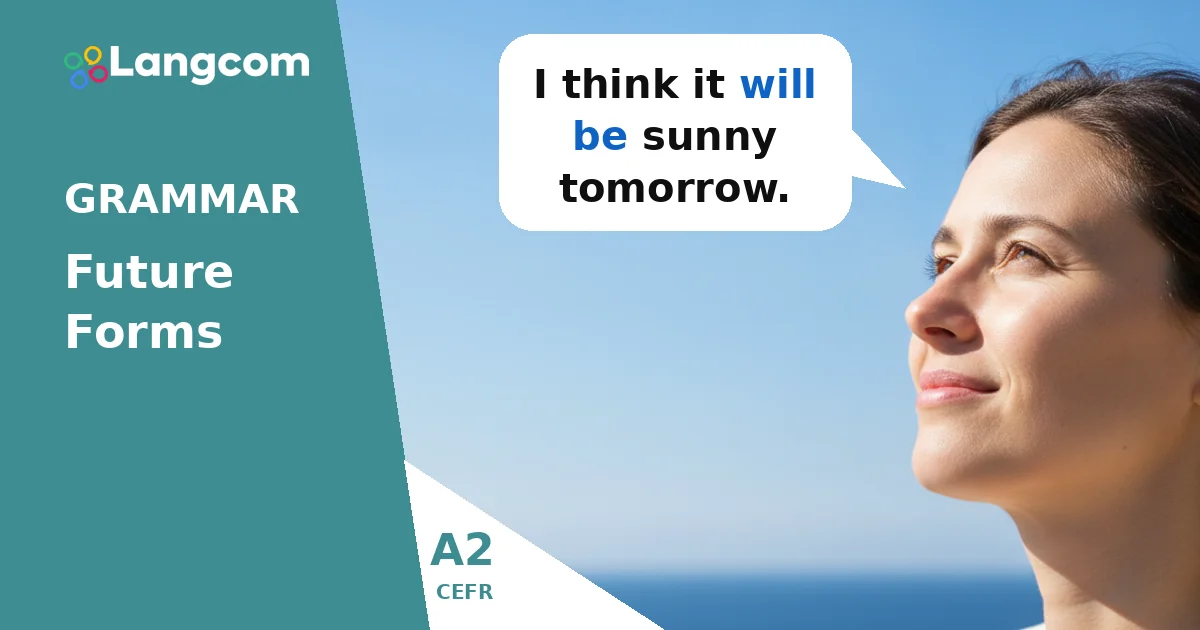

In English, you can talk about the future using will, the present continuous, or the present simple, but each has a different use. نحن نستخدم will for predictions about the future or for decisions we make right now. For example, I think it will rain tomorrow.
نحن نستخدم present continuous for plans and arrangements that are already fixed, often with other people. Think of things you write in your calendar, like I am meeting my friend at 7 PM. Finally, the present simple is for future events that are part of a timetable or schedule, like public transport or movie times. For instance, The train leaves at 10:30 AM. Understanding these differences helps you speak more accurately about what’s coming next.
When Do We Use ‘Will’ for the Future?
نحن نستخدم will to talk about things we think will happen in the future. This is often for predictions, especially when we are not 100% sure.
- الاستخدام will + base verb for predictions. You can use words like I think, I don’t think, I’m sure, maybe, ، أو probably.
كما أننا نستخدم will for decisions we make at the moment of speaking. These are not plans you made before; they are spontaneous.
- الاستخدام will + base verb for spontaneous decisions.
✍️ لست متأكدًا من مستواك؟
خُذ اختبار تحديد المستوى المجاني الخاص بنا واحصل على تعليقات مخصصة من ممتحنين معتمدين من كامبريدج.
قم بإجراء اختبار تحديد المستوى المجانيHow to Use the Present Continuous for Future Plans?
ال present continuous is not only for actions happening now. We also use it to talk about future arrangements.
- الاستخدام subject + am/is/are + verb-ing for fixed plans. These are things you have already organized, often with other people, and usually have a specific time or date.
- Think of it like looking at your calendar or diary.
Can the Present Simple Talk About the Future?
Yes, the present simple can talk about the future, but only for specific types of events. It is for events that are part of a timetable or schedule.
- الاستخدام subject + base verb (or verb + -s/-es for he/she/it) for timetabled events.
- This includes public transport, movie times, school classes, and shop opening hours.
Summary: Choose the Right Future Form
Remember these simple rules to choose the correct future form:
- الاستخدام will for things you predict or decide right now.
- Use the present continuous for plans you have already made and arranged.
- Use the present simple for events that follow a fixed timetable.
| Future Form | What it means | Example |
|---|---|---|
| Will + base verb | Predictions or spontaneous decisions | I think it will be cold. |
| Present Continuous (am/is/are + -ing) | Fixed arrangements or plans | We are visiting London next month. |
| Present Simple (verb + -s/-es) | Timetables, schedules, fixed events | The concert starts at 9 PM. |
أمثلة
- I think it will be sunny tomorrow.
- I don’t think Peru will win the match.
- I’m sure you’ll pass the English test.
- Maybe they’ll be late.
- I’ll probably go to bed late.
- The phone’s ringing! I’ll answer it.
- My parents are coming to visit tomorrow afternoon.
- We’re having a holiday in Florida next year.
- I’m seeing the doctor later this morning.
- The shop closes at 5 PM.
- The train leaves at 2:45.
- The film starts in 10 minutes.
التدريب
هل أنت مستعد للحصول على شهادتك؟
يُعد برنامج Langcom الطلاب لامتحانات كامبريدج وIELTS وTOEFL وDELE وSIELE وMichigan.
ابدأ مع Langcomالأخطاء الشائعة لدى المتحدثين باللغة الإسبانية
Spanish speakers sometimes use will for all future situations, which is not always correct in English.
- Mistake: استخدام will for fixed arrangements.
I will meet my friends tonight. (Incorrect if it’s a fixed plan) - Correction: Use the present continuous for fixed plans.
I am meeting my friends tonight. (Correct for a fixed plan)
Another common mistake is using the present simple for personal arrangements instead of timetabled events.
- Mistake: استخدام present simple for personal plans.
I go to the dentist next week. (Incorrect for a personal appointment) - Correction: Use the present continuous for personal appointments.
I am going to the dentist next week. (Correct for a personal appointment)
الأسئلة الشائعة
What is the easiest way to remember when to use ‘will’?
Think of will for things you predict (I think it will rain) or for decisions you make right now, without prior planning (I’ll help you!).
When should I use the present continuous for the future?
Use the present continuous for future plans that are already organized and fixed, like appointments or social events. Imagine them written in your calendar: I am having dinner with my family on Saturday.
Does the present simple always mean ‘now’?
No, the present simple can also refer to the future when talking about timetables, schedules, or fixed events. For example, The bus arrives at 8 AM.
How are future forms tested in the A2 Key exam?
In the A2 Key exam, you might see questions that test your understanding of future forms in tasks like multiple-choice grammar questions or sentence completion. You will need to choose the correct future form (will, present continuous, ، أو present simple) based on the context of the sentence.




0 تعليق