

What are Common Clothes for Every Day?
Many clothes are for daily use. You wear them often.
- A T-shirt is a casual top, often with short sleeves. I wear a T-shirt in summer.
- A shirt is a top with a collar and buttons. He wears a shirt to work.
- A jumper (or sweater) is a warm top for cold weather. My favourite jumper is blue.
- Jeans are trousers made of denim. They are usually blue. I wear jeans almost every day.
- Trousers are clothes for your legs. He needs new trousers for school.
- Socks cover your feet and go inside your shoes. She is wearing red socks.
- Shoes are for your feet. These shoes are very comfortable.
- Boots are like shoes but cover more of your leg, above the ankle. He wears boots in winter.
What Accessories Do People Wear?
Accessories are extra items that complete an outfit.
- A belt goes around your waist to hold up trousers or a skirt. He wears a black belt.
- A scarf is a piece of fabric worn around the neck, head, or shoulders. It’s cold, so wear a scarf.
- Gloves cover your hands, often for warmth. She wears gloves when it snows.
- Earrings are a type of jewellery worn on the ears. Those are lovely earrings.
- Jewellery is a general word for decorative items like earrings, necklaces, , 和 rings. She likes wearing jewellery.
What Clothes Are for Special Occasions or Weather?
Some clothes are for specific events or weather conditions.
- A dress is a piece of clothing for women or girls that covers the body and extends down over the legs. She wore a beautiful dress to the party.
- A coat is a warm outer garment worn in cold weather. Put on your coat, it’s chilly outside.
- A raincoat is a waterproof coat worn to protect from rain. Don’t forget your raincoat, it’s raining.
How Do We Talk About Wearing Clothes?
The main verb to use when talking about clothes on your body is wear.
- I wear a uniform to school.
- She is wearing a red dress today.
- You can also use colours to describe clothes. He likes wearing red socks. My boots are black.
| Item | Example Sentence |
|---|---|
| Shirt | He wears a white shirt to work. |
| Dress | She bought a new dress for the party. |
| Jeans | I like wearing blue jeans. |
| Scarf | It’s cold, so wear a scarf. |
| Boots | My boots are black. |
| Raincoat | You need a raincoat today. |
示例
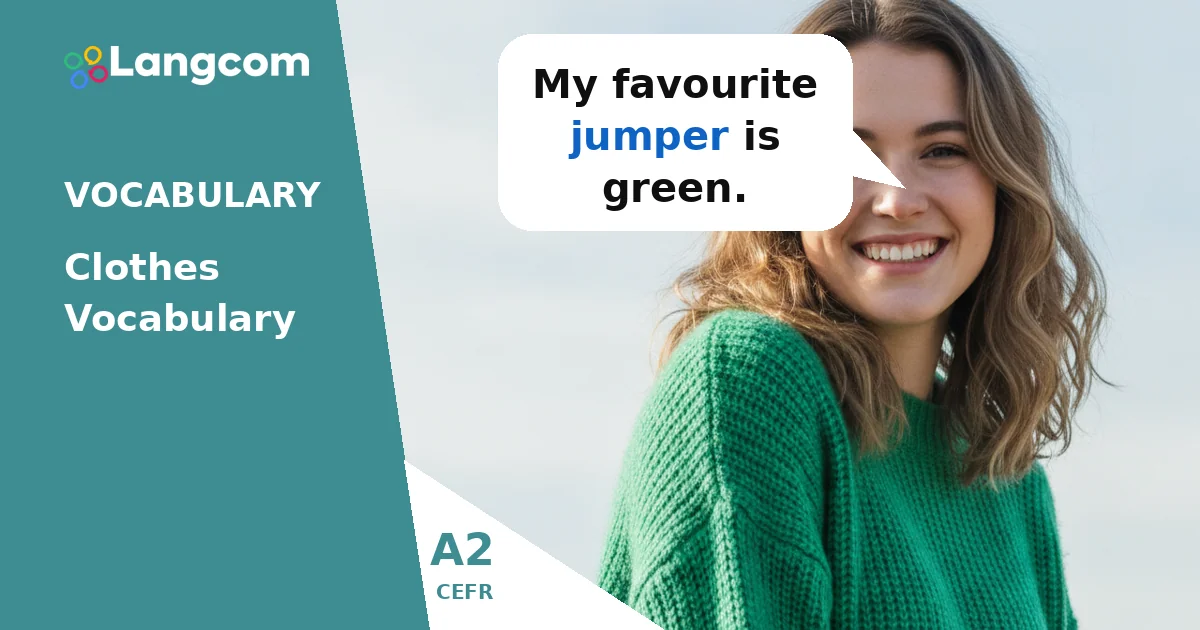
- My favourite jumper is green.
- She always wears earrings.
- He bought new boots for winter.
- Do you need a scarf in this cold weather?
- I wear jeans almost every day.
- The man in the black coat is my teacher.
练习
西班牙语母语者常犯的错误
Using ‘use’ instead of ‘wear’
In Spanish, you often use ‘usar’ for clothes. In English, we use wear.
- 错误: I use a T-shirt.
- 正确: I wear a T-shirt.
- 正确: She is wearing a dress.
Singular and Plural Forms
Some clothing items are always plural in English, even if they refer to one item. This is different from some other languages.
- 错误: I need a jean.
- 正确: I need jeans. (You can also say a pair of jeans.)
- 错误: My trouser is new.
- 正确: My trousers are new. (Or My pair of trousers is new.)
常见问题
What is the difference between shoes and boots?
Shoes usually cover only your foot, often below the ankle. Boots cover your foot and part of your leg, going above the ankle. For example, trainers are shoes, but winter boots are boots.
Can I say ‘a trousers’?
No, trousers is always a plural noun in English. You should say trousers (e.g., My trousers are black.) or a pair of trousers (e.g., I bought a new pair of trousers.).
What is ‘jewellery’?
Jewellery is a general word for decorative items worn on the body, such as earrings, necklaces, bracelets, , 和 rings. It is an uncountable noun, so we do not say ‘jewelleries’.
What is the difference between a ‘jumper’ and a ‘sweater’?
There is no difference! Jumper 和 sweater are two words for the same item of clothing – a warm knitted top. Jumper is more common in British English, and sweater is more common in American English.




0 条评论