

Mastering eye idioms and metaphors is a fantastic way to make your C1 English sound more natural and sophisticated. These expressions add color and depth to your communication, moving beyond literal meanings to convey complex ideas efficiently. For example, when you see eye to eye on a topic, it means you completely agree, not that you are looking into someone’s eyes. Similarly, to turn a blind eye to a problem means to deliberately ignore it, not physically close your eyes. Understanding these nuances is crucial for advanced learners. By integrating phrases like in the blink of an eye ou keep your eyes on the prize, you will express yourself with greater fluency and cultural understanding, impressing native speakers and improving your overall comprehension of English.
What Are Eye Idioms and Metaphors?
English is rich with idioms and metaphors. These are phrases where the meaning is not obvious from the individual words. Eye idioms, specifically, use words related to ‘eyes’ or ‘vision’ to express a wide range of human experiences, emotions, and situations.
For C1 learners, understanding these expressions is vital. They are common in everyday conversation, literature, and media. Learning them helps you sound more like a native speaker and understand complex texts better.
✍️ Not sure which level you are?
Take our free placement test and get personalized feedback from certified Cambridge examiners.
Faça nosso teste de nivelamento GRATUITOCommon Eye Idioms for C1 Learners
Let’s explore some essential eye idioms and metaphors. Each one adds a unique nuance to your English vocabulary.
-
Catch your eye: To attract your attention.
Exemplo: The bright red dress immediately caught her eye.
-
Feast your eyes on: To look at something with great pleasure and admiration.
Exemplo: Feast your eyes on this incredible sunset!
-
Keep your eyes on the prize: To stay focused on a goal or objective, especially when there are distractions.
Exemplo: Despite all the challenges, she kept her eyes on the prize and finished her degree.
-
In the public eye: Being famous and receiving a lot of attention from the general public.
Exemplo: As a celebrity, she’s constantly in the public eye.
-
See eye to eye on: To agree completely with someone about something.
Exemplo: My boss and I don’t always see eye to eye on marketing strategies.
-
A bird’s eye view of: A general view from above, often implying a comprehensive perspective.
Exemplo: From the airplane, we had a bird’s eye view of the city.
-
In the blink of an eye: Extremely quickly; almost instantly.
Exemplo: The magician made the card disappear in the blink of an eye.
-
Turn a blind eye to: To deliberately ignore something wrong or unpleasant that you should deal with.
Exemplo: The manager decided to turn a blind eye to the minor rule violation.
-
In your mind’s eye: In your imagination or memory; how you picture something mentally.
Exemplo: In my mind’s eye, I can still see the old house where I grew up.
-
Without batting an eye: Without showing any surprise, fear, or emotion, even in a shocking or difficult situation.
Exemplo: He heard the bad news and accepted it without batting an eye.
-
Have eyes in the back of your head: To be very aware of what is happening around you, even behind you, often used to describe someone who is very observant or watchful.
Exemplo: Parents often feel like they need to have eyes in the back of their head when their children are playing.
Exemplos
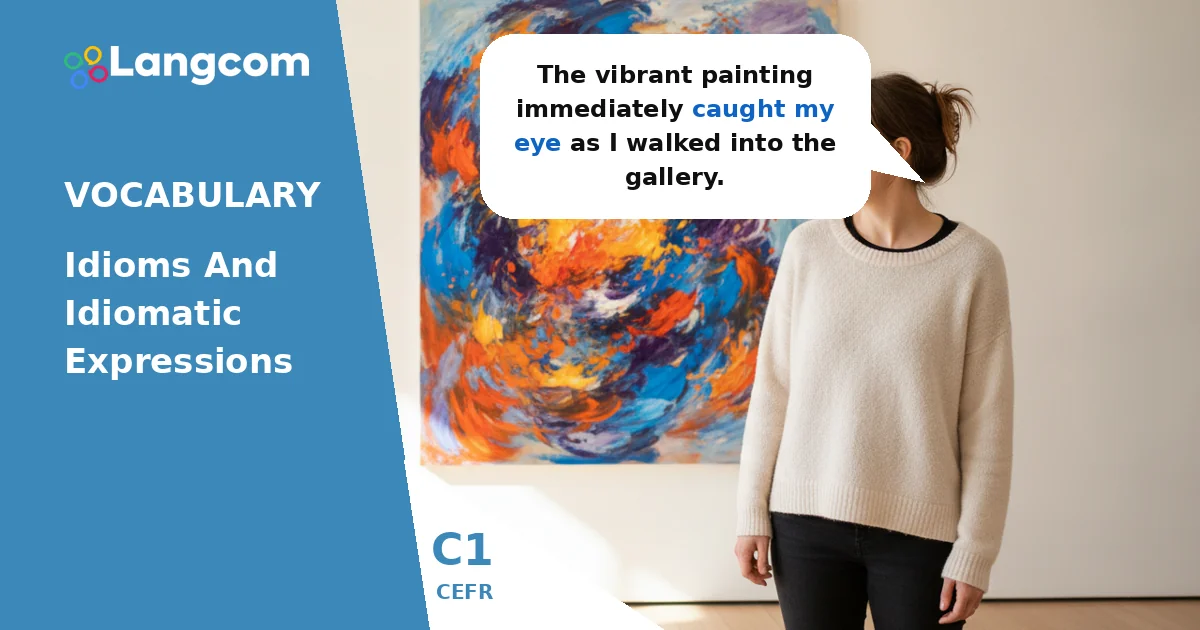
- The vibrant painting immediately caught my eye as I walked into the gallery.
- After a long hike, we stopped to feast our eyes on the stunning mountain panorama.
- It’s important to keep your eyes on the prize during a challenging project.
- Politicians are always in the public eye, so their actions are closely scrutinized.
- My brother and I rarely see eye to eye on political issues.
- The drone footage gave us a perfect bird’s eye view of the entire construction site.
- The car sped past in the blink of an eye.
- The company chose to turn a blind eye to the small ethical breach.
- Even now, in my mind’s eye, I can recall every detail of that memorable trip.
- She faced the difficult questions without batting an eye.
- A good teacher often seems to have eyes in the back of their head.
Prática
Ready to earn your certificate?
Langcom prepares students for Cambridge, IELTS, TOEFL, DELE, SIELE and Michigan exams.
Get started with LangcomErros comuns entre falantes de espanhol
Spanish speakers often make direct, literal translations, which can lead to misunderstandings with English idioms. Remember that idioms are not meant to be taken literally.
-
Literal Translation of See eye to eye: Do not translate see eye to eye as “ver ojo a ojo.” This sounds very strange in English. The correct meaning is “to agree.”
Incorreto: We see eye to eye about the color of your eyes. (This implies literally looking at eyes.)
Correto: We see eye to eye on the new project proposal. (This means agreement.)
-
Confuso Turn a blind eye with physical action: This idiom means to ignore something, not to physically close your eyes. In Spanish, “hacer la vista gorda” is a similar concept.
Incorreto: He turned a blind eye to the sun. (This means he physically closed his eyes.)
Correto: The teacher turned a blind eye to the students whispering during the test. (This means she ignored it.)
-
Misinterpreting In the blink of an eye: This idiom means “very quickly.” Do not translate it as “en un parpadeo de ojo” literally, as the English expression is fixed.
Incorreto: He blinked his eye in the blink of an eye. (Redundant and awkward.)
Correto: The entire event was over in the blink of an eye. (Meaning it happened very fast.)
Perguntas frequentes
What is an idiom?
An idiom is a group of words established by usage as having a meaning not deducible from those of the individual words. For example, kick the bucket means ‘to die’, not literally to kick a bucket.
Why are eye idioms important for C1 English learners?
At the C1 level, you need to understand and use a wide range of vocabulary, including idiomatic expressions. Eye idioms are common and help you express yourself more naturally, understand native speakers, and appreciate the nuances of the English language. They are a sign of advanced fluency.
Can I use these eye idioms in formal writing?
Many eye idioms, like see eye to eye ou keep your eyes on the prize, are appropriate for both formal and informal contexts. However, some, like have eyes in the back of your head, might be more suitable for informal or semi-formal situations. Always consider your audience and the context.
How can I remember so many idioms?
The best way to remember idioms is to use them! Try to incorporate them into your speaking and writing. Pay attention to how native speakers use them in movies, books, and conversations. Creating example sentences for each idiom, like I always keep my eyes on the prize when I’m studying for an exam, can also help.


0 Comentários