
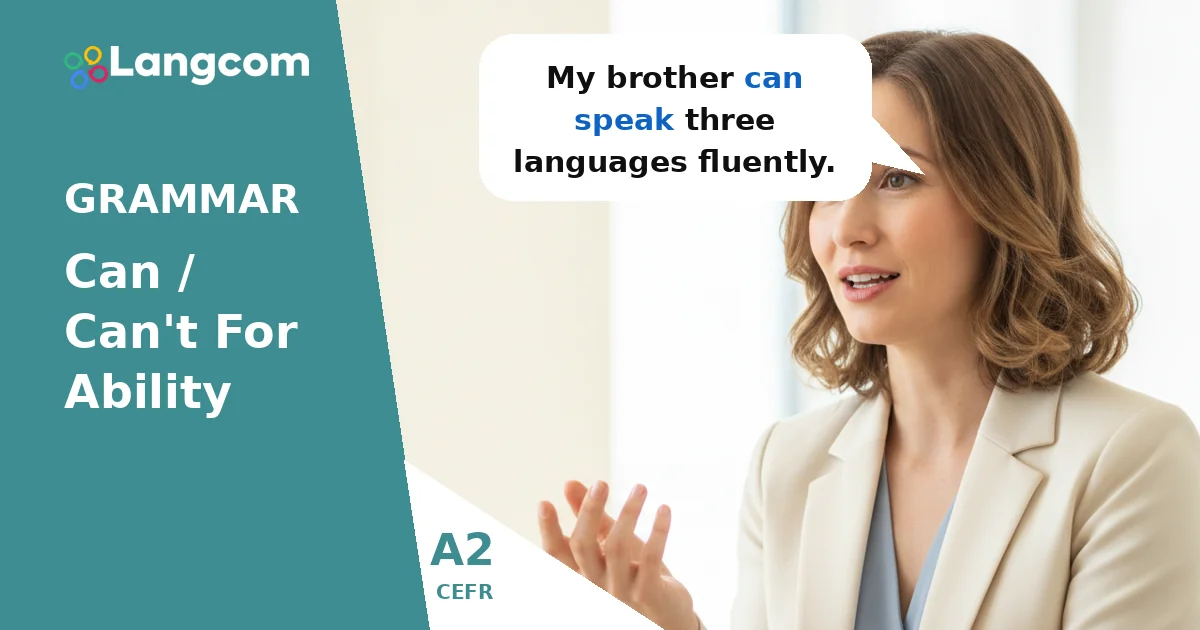

What is ‘Can’ for Present Ability?
Can is a modal verb. We use it to show that someone has the skill, knowledge, or possibility to do something in the present.
- It tells us what is possible or what someone is capable of doing right now.
- The structure is always Subject + can + the base form of the verb.
For example:
- I can play the guitar. (This means I have the skill to play it.)
- She can run very fast. (This means she has the physical ability.)
How Do We Use 'Can't' for Inability?
Can't is the negative form of can. It is short for cannot.
- 当社では can't to show that someone does 違う have the skill, knowledge, or possibility to do something in the present.
- The structure is Subject + can't + the base form of the verb.
For example:
- He can't cook well. (He does not have the skill to cook well.)
- We can't meet tomorrow. (It is not possible for us to meet.)
Asking Questions with 'Can'
To ask about someone's ability or if something is possible, we put Can at the beginning of the question.
- The structure is Can + Subject + the base form of the verb?
- For short answers, we use Yes, + Subject + can. または No, + Subject + can't.
For example:
- Can you swim? Yes, I can. (I have the ability.)
- Can she speak French? No, she can't. (She does not have the skill.)
What About Past Ability? ('Could' and 'Couldn't')
While can そして can't are for present ability, we use could そして couldn't ~のために past ability.
- Could means 'was able to' or 'had the ability to' in the past.
- Couldn't means 'was not able to' or 'did not have the ability to' in the past.
For example:
- When I was young, I could climb trees. (I had the ability in the past.)
- My grandfather couldn't use a computer. (He did not have the ability in the past.)
Key Rules for Using 'Can' and 'Can't'
Can そして can't are special verbs called modal verbs. They follow simple rules:
- No 'to' after can/can't: Always use the base form of the verb without to.
正しい: I can play.
誤り: I can to play. - No '-s' for 'he/she/it': Can does not change its form for any subject.
正しい: He can sing.
誤り: He cans sing. - No 'do/does' in questions or negatives: Do not use auxiliary verbs do または does with can.
正しい: Can you help?
誤り: Do you can help?
| フォーム | Structure | 例 |
|---|---|---|
| Positive | Subject + can + Base Verb | I can sing. |
| Negative | Subject + can't + Base Verb | She can't dance. |
| Question | Can + Subject + Base Verb? | Can you swim? |
例
- My brother can speak three languages fluently.
- I can't drive a car yet, but I'm learning.
- Can you help me with this heavy box?
- She can play the piano beautifully.
- We can't come to the party tonight.
- The baby can walk now!
- They can't hear you from here.
- Can I borrow your pen for a moment?
練習
スペイン語話者がよく犯す間違い
Spanish speakers sometimes make specific mistakes with can そして can't:
- Adding 'to' after can: In Spanish, you might use 'poder + infinitive', but in English, can is directly followed by the base verb.
誤り: I can to swim.
正しい: I can swim. - Using 'do/does' in questions: Can is a modal verb, so it forms questions by itself.
誤り: Do you can speak English?
正しい: Can you speak English? - Changing 'can' for 'he/she/it': Remember, can never changes its form.
誤り: She cans play tennis.
正しい: She can play tennis.
よくある質問
What is 'can' used for in English?
Can is used to express present ability, possibility, or permission. For example, I can sing means you have the skill to sing.
How do I make 'can' negative?
~を作るには can negative, you use can't (short for cannot). For example, I can't swim means you are not able to swim.
Is 'can' a regular verb?
No, can is a modal verb. This means it has special rules: it doesn't change form for different subjects (like he cans), and it's always followed by the base form of another verb without to.
How is 'can' used in the A2 Key (KET) exam?
In the A2 Key exam, you might see can そして can't in reading tasks (e.g., understanding descriptions of abilities) or listening tasks (e.g., identifying what someone can or can't do). You may also need to use it correctly in writing tasks, such as describing yourself or others.
What is the difference between 'can' and 'could'?
Can is used for present ability (what you are able to do now), while could is used for past ability (what you were able to do in the past). For example, I can speak English (now) vs. When I was five, I could ride a bike (in the past).

コメント 0 件