

How Do We Form Present Perfect Negatives?
To make a negative sentence in the Present Perfect, we follow a simple structure:
- Subject + have/has + not + past participle
We use have not for I, you, we, they. We use has not for he, she, it.
You can also use contractions to speak more naturally:
- have not becomes haven’t
- has not becomes hasn’t
🎓 Impara l'inglese con il metodo misto
Piccoli gruppi · Tutor IA disponibile 24 ore su 24, 7 giorni su 7 · Preparazione agli esami di Cambridge
Piani da $39 $79 al mese
How Do We Form Present Perfect Questions?
To ask a question in the Present Perfect, we change the word order. The auxiliary verb have oppure has comes before the subject:
- Have/Has + subject + past participle?
We use Have for I, you, we, they. We use Has for he, she, it.
For yes/no questions, the answer is usually short:
- Yes, I have. / No, I haven’t.
- Yes, she has. / No, she hasn’t.
Using ‘Ever’ and ‘Never’ with Present Perfect
Ever e never are common adverbs with the Present Perfect. They talk about experiences at any time up to now.
- We use ever in questions. It means ‘at any time in your life’.
- We use never in negative sentences. It means ‘not at any time’. Remember, never already makes the sentence negative, so do not use not with never.
Using ‘Yet’ with Present Perfect Negatives and Questions
Yet is another useful adverb. We use it to talk about something that we expect to happen.
- In negative sentences, yet means ‘up to this time’. It usually comes at the end of the sentence.
- In questions, yet asks if something has happened up to this time. It also usually comes at the end of the question.
| Type | Structure | Example |
|---|---|---|
| Negative (Full) | Subject + have/has + not + past participle | I have not seen her. |
| Negative (Contracted) | Subject + haven’t/hasn’t + past participle | She hasn’t finished. |
| Question (Yes/No) | Have/Has + subject + past participle? | Have you eaten? |
| Question (Wh-) | Wh- word + have/has + subject + past participle? | What have you done? |
Esempi
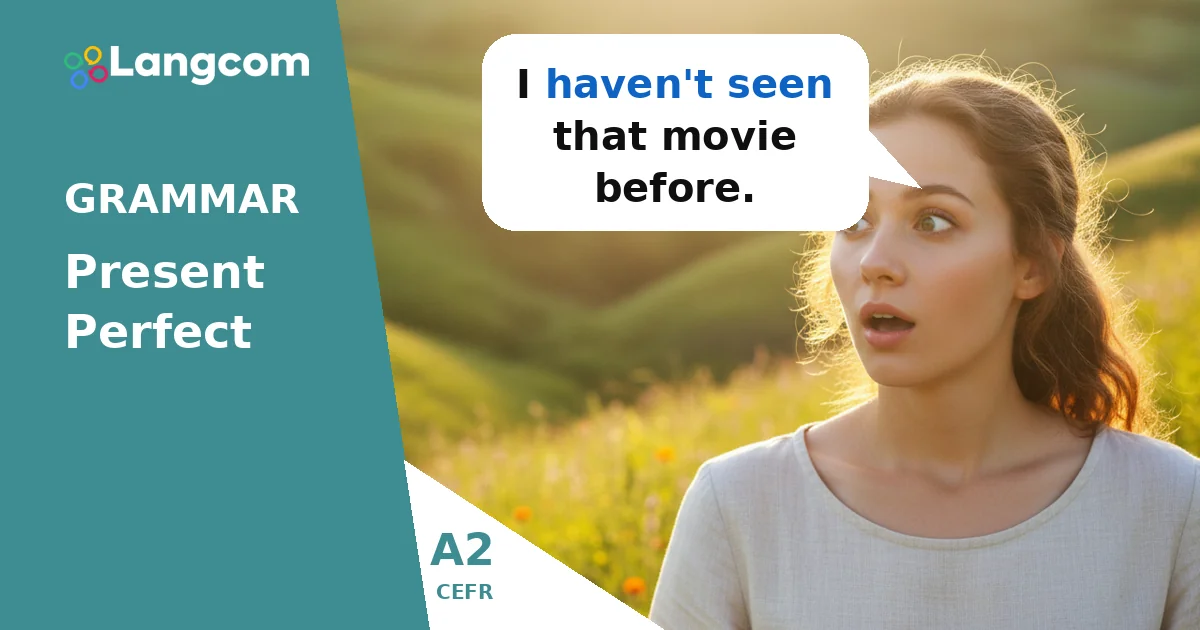
- I haven’t seen that movie before.
- She hasn’t finished her book yet.
- We haven’t eaten dinner.
- They have never visited France.
- He has never tried sushi.
- Have you ever flown in a helicopter?
- Has she called you back yet?
- Have they arrived at the party?
- What have you done today?
- Where has he gone?
Esercitazione
💬 Hai bisogno di una consulenza personalizzata?
In qualità di Centro autorizzato di preparazione agli esami Cambridge, possiamo aiutarti a scegliere il corso e la certificazione più adatti alle tue esigenze. Contatta oggi stesso i nostri consulenti.
Chatta con un consulente su WhatsAppErrori comuni per chi parla spagnolo
Chi parla spagnolo a volte commette questi errori:
- Using ‘don’t’ or ‘doesn’t’ instead of ‘haven’t’ or ‘hasn’t’: In Spanish, you might use ‘no’ with the verb. In English, for the Present Perfect, you must use have not oppure has not.
Errato: I don’t seen that movie.
Corretto: I haven’t seen that movie. - Incorrect word order in questions: Remember to put have/has before the subject.
Errato: You have ever been to London?
Corretto: Have you ever been to London? - Using ‘not’ with ‘never’: Never already makes the sentence negative.
Errato: I haven’t never visited Rome.
Corretto: I have never visited Rome.
Domande frequenti
What is the main difference between ‘haven’t’ and ‘hasn’t’?
The difference is the subject. We use haven’t for I, you, we, they. We use hasn’t for he, she, it.
Can I use ‘ever’ in negative sentences?
No, we usually use ever only in questions. For negative sentences, use never oppure not…any, for example: I haven’t ever been there is less common than I have never been there oppure I haven’t been there at all.
Where does ‘yet’ go in a sentence?
Yet usually goes at the end of a negative sentence or a question, for example: I haven’t finished yet. oppure Have you eaten yet?
Is ‘Have you been to…?’ the same as ‘Did you go to…?’
No, they are different. Have you been to…? (Present Perfect) asks about an experience at any time up to now. Did you go to…? (Simple Past) asks about a specific trip in the past, usually with a specific time mentioned or understood.



0 Commenti