
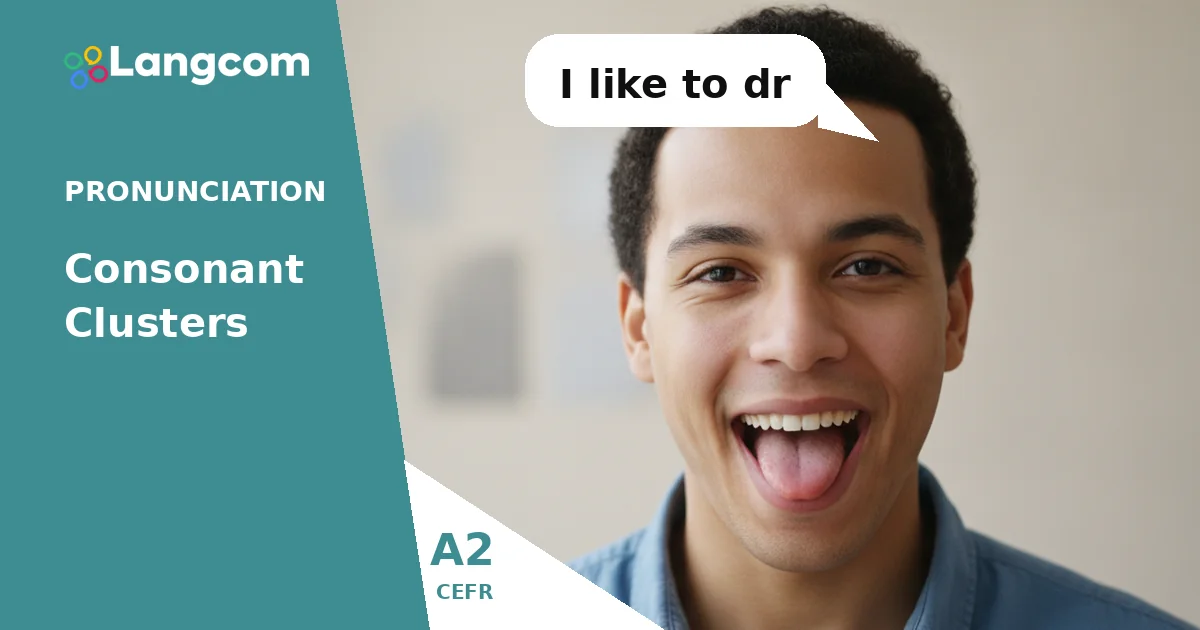

What Are Consonant Clusters?
A consonant cluster is simply a group of two or more consonant sounds together. There is no vowel sound between them.
For example, in the word street, the letters s, t, et r make three consonant sounds together: /str/. This is a consonant cluster.
- English has many consonant clusters.
- They can appear at the beginning, middle, or end of words.
🎓 Apprenez l'anglais grâce à la méthode mixte
Petits groupes · Tuteur IA disponible 24 h/24, 7 j/7 · Préparation aux examens de Cambridge
Plans provenant de $39 $79 par mois
Why Are Consonant Clusters Important for A2 Learners?
Pronouncing consonant clusters correctly helps you speak English clearly. If you miss a sound or add an extra sound, your words might be difficult to understand.
- Clearer Speech: People will understand you better.
- Better Listening: You will recognize words more easily when native speakers talk.
- More Natural Sound: Your English will sound more like a native speaker’s.
How to Pronounce Consonant Clusters
The key is to say each consonant sound clearly, one after the other, without adding any extra vowel sounds.
- Listen Carefully: Pay attention to how native speakers say words with clusters.
- Practice Slowly: Start by saying the word very slowly, focusing on each sound.
- Blend Sounds: Try to connect the consonant sounds smoothly. Do not stop between them.
For example, to say strong:
- First, make the /s/ sound.
- Then, make the /t/ sound.
- Next, make the /r/ sound.
- Finally, add the vowel and /ŋ/ sound.
Practice saying s-t-r-o-n-g, then faster: strong.
Common Consonant Clusters in English
Consonant clusters can be found in different positions in words:
- Beginning of words (Initial Clusters): These are often challenging. For example:
- bl as in blue
- fr as in friend
- sk as in sky
- spr as in spring
- End of words (Final Clusters): These can also be tricky. For example:
- nd as in hand
- st as in fast
- mp as in jump
- xt as in next
- Middle of words (Medial Clusters): These often connect two syllables. For example:
- str as in in-struc-tion
- mpl as in ex-am-ple
| Cluster Type | Example Word |
|---|---|
| Initial (2 consonants) | pl dans play |
| Initial (3 consonants) | scr dans scream |
| Final (2 consonants) | ft dans soft |
| Final (3 consonants) | kst dans text |
| Medial (2 consonants) | ct dans doctor |
Exemples
- I like to drink water.
- She has a blue dress.
- The street is very crowded.
- He is my best friend.
- Can you help me with this task?
Entraînement
💬 Vous avez besoin de conseils personnalisés ?
En tant que centre de préparation agréé par Cambridge, nous pouvons vous aider à choisir la formation et la certification qui vous conviennent. Discutez-en dès aujourd'hui avec nos conseillers.
Discutez avec un conseiller sur WhatsAppErreurs courantes chez les hispanophones
Many Spanish speakers make a common mistake with initial ‘s’ clusters. They often add an ‘e’ sound before the ‘s’.
- Incorrect : E-school (adding an ‘e’ sound)
- Correct : School (start directly with the ‘s’ sound)
Remember, in English, words like student, sport, et speak start directly with the /s/ sound, not /es/.
Questions fréquemment posées
What is the difference between a consonant and a vowel?
A consonant sound is made when you block air in your mouth (e.g., /p/, /t/, /s/). A vowel sound is made with an open mouth, letting air flow freely (e.g., /a/, /e/, /i/).
Are consonant clusters difficult for all English learners?
Consonant clusters can be challenging for many learners, especially if their native language has fewer clusters. However, with practice, anyone can improve their pronunciation.
How can I practice consonant clusters at home?
You can practice by listening to English songs, watching movies, and repeating words. Record yourself speaking and compare it to a native speaker. Focus on words like street, strong, desk, et asked.
Do all consonant clusters have two consonants?
No, consonant clusters can have two, three, or even four consonant sounds. For example, st (two) in stop, str (three) in strong, et glimpsed (four) in glimpsed.


0 commentaire