

What Are Nationalities?
A nationality tells us the country a person is from. It is an adjective. It describes a person or a thing.
- He is from Italy. He is Italian.
- She is from China. She is Chinese.
We use nationalities to talk about people, food, music, and many other things.
🎓 Aprende inglés con el método mixto
Grupos reducidos · Tutor de IA disponible las 24 horas del día, los 7 días de la semana · Preparación para los exámenes de Cambridge
Planes de $39 $79 al mes
How Do We Form Nationalities?
Many nationalities follow common patterns. You can often guess the nationality from the country name.
- -ish: For countries like Poland → Polish, Turkey → Turkish, the UK → British.
- -an / -ian: For countries like America → American, Italy → Italian, Russia → Russian, Australia → Australian.
- -ese: For countries like China → Chinese, Japan → Japanese.
- -ch / -sh: For countries like France → French, Spain → Spanish.
Some nationalities are irregular, but these patterns are a good start.
Important Rule: Capital Letters!
In English, all nationalities always start with a capital letter. This is very important.
- I am Spanish. (NOT I am spanish.)
- He is American. (NOT He is american.)
- This is Japanese food. (NOT This is japanese food.)
Using Nationalities in Sentences
You can use nationalities in simple sentences to describe people or things.
- To say where someone is from: I am from Mexico. I am Mexican.
- To describe a person: She is a British singer.
- To describe an object: This is an Italian car.
| País | Nationality |
|---|---|
| Spain | Spanish |
| The UK | British |
| USA | American |
| Italy | Italian |
| China | Chinese |
| Japan | Japanese |
| Mexico | Mexican |
| Germany | German |
| France | French |
| Poland | Polish |
| Australia | Australian |
| Turkey | Turkish |
Ejemplos
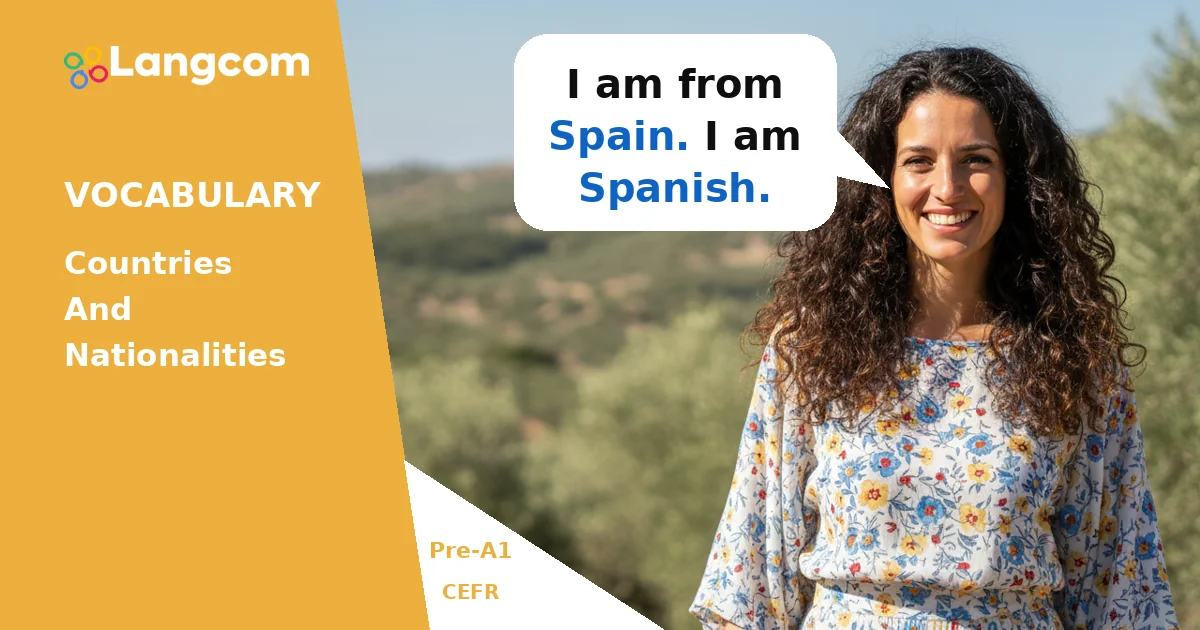
- I am from Spain. I am Spanish.
- He is from the UK. He is British.
- She is from the USA. She is American.
- We are from Poland. We are Polish.
- They are from Japan. They are Japanese.
- This is a Chinese restaurant.
Práctica
💬 ¿Necesitas asesoramiento personalizado?
Como centro autorizado de preparación para los exámenes de Cambridge, podemos orientarte para que elijas el curso y la certificación más adecuados. Habla hoy mismo con nuestros asesores.
Chatea con un asesor por WhatsAppErrores habituales de los hispanohablantes
Not Using Capital Letters
In Spanish, nationalities do not always start with a capital letter. In English, they always do!
- Correct: I am Italian.
- Incorrect: I am italian.
Using ‘from’ or ‘of’ with the Nationality
You say ‘I am from [country]’, but ‘I am [nationality]’. Do not use ‘from’ or ‘of’ with the nationality itself.
- Correct: She is Russian.
- Incorrect: She is from Russian.
- Incorrect: She is of Russia.
Adding ‘person’ unnecessarily
Often, you just need the nationality adjective, not ‘person’ after it.
- Correct: He is French.
- Less natural: He is a French person.
Preguntas más frecuentes
Do nationalities always start with a capital letter in English?
Yes, always! For example, Spanish, American, Chinese.
Can I use a nationality to describe a thing, not just a person?
Yes, you can. For example, you can say Japanese food, British music, o Italian shoes.
Is ‘American’ a country or a nationality?
American is a nationality. The country is the USA o the United States.




0 Comentarios