
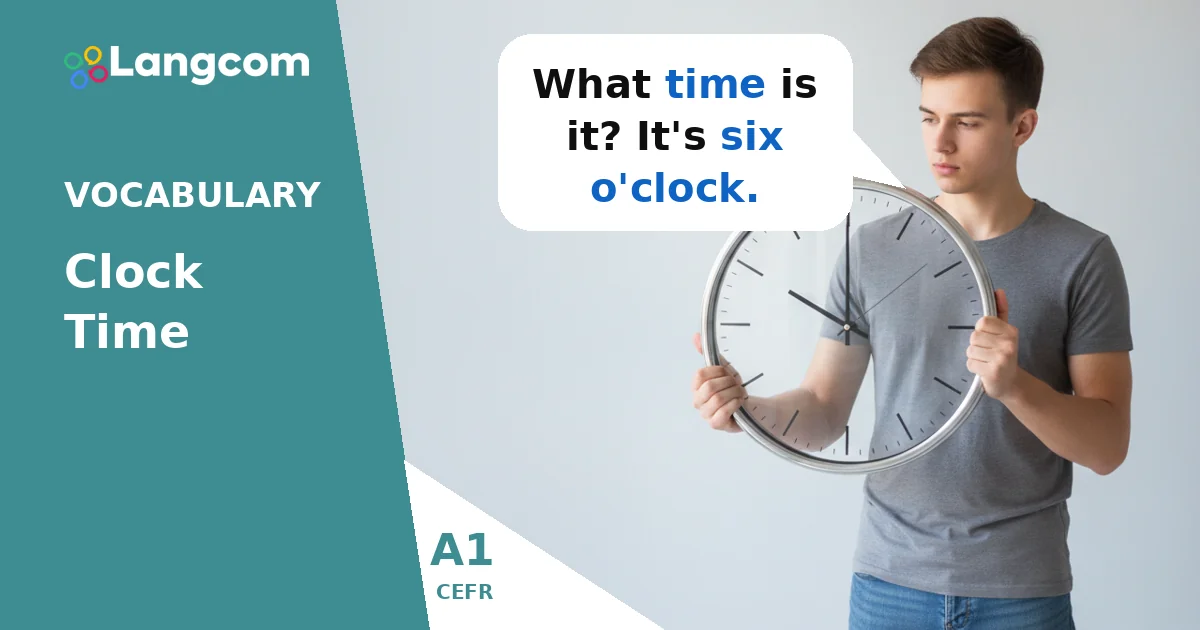

How do you ask about the time?
When you want to know what time it is, you can use a simple question.
- What time is it?
- What’s the time?
These are the most common ways to ask.
🎓 Learn English with the Blended method
Small groups · 24/7 AI Tutor · Cambridge preparation
Plans from $39 $79 per month
How do you say exact hours?
For exact hours, we use the word o’clock. This means ‘of the clock’.
- It’s one o’clock. (1:00)
- It’s seven o’clock. (7:00)
- It’s eleven o’clock. (11:00)
We only use o’clock when there are no minutes.
How do you say minutes after the hour? (The ‘past’ method)
When the minutes are from 1 to 30, we use the word past. We say the minutes first, then past, then the hour.
- It’s five past two. (2:05)
- It’s ten past nine. (9:10)
- It’s twenty-five past six. (6:25)
Remember: minutes first, then past, then the hour.
How do you say minutes before the hour? (The ‘to’ method)
When the minutes are from 31 to 59, we use the word to. We say how many minutes are left until the next hour.
- It’s twenty-five to four. (3:35)
- It’s ten to eight. (7:50)
- It’s five to twelve. (11:55)
Think about the next hour. How many minutes until then?
What about special times: 15 and 30 minutes?
For 15 minutes and 30 minutes, we have special words:
- 15 minutes: We say a quarter.
- It’s a quarter past three. (3:15)
- It’s a quarter to nine. (8:45)
- 30 minutes: We say half past.
- It’s half past five. (5:30)
- It’s half past ten. (10:30)
These are very common ways to say these times.
How do you say time the ‘digital’ way?
This is often the easiest way for beginners. You just say the numbers you see on a digital clock.
- It’s three fifteen. (3:15)
- It’s seven thirty. (7:30)
- It’s one forty-two. (1:42)
- It’s nine fifty-five. (9:55)
This method is simple and always correct.
| Time | Common Way (Past/To) | Digital Way |
|---|---|---|
| 1:00 | It’s one o’clock. | It’s one o’clock. |
| 2:05 | It’s five past two. | It’s two oh five. |
| 3:15 | It’s a quarter past three. | It’s three fifteen. |
| 4:30 | It’s half past four. | It’s four thirty. |
| 5:40 | It’s twenty to six. | It’s five forty. |
| 6:45 | It’s a quarter to seven. | It’s six forty-five. |
Examples
- What time is it? It’s six o’clock.
- The train leaves at a quarter past eight.
- I have lunch at half past twelve.
- The movie starts at twenty to seven.
- Can we meet at four forty-five?
- It’s eight minutes past three.
Practice
💬 Need personalized guidance?
As an Authorized Cambridge Preparation Centre, we can guide you to the right course and certification. Chat with our advisors today.
Chat with an Advisor on WhatsAppCommon mistakes for Spanish speakers
Spanish speakers sometimes make these mistakes:
- Using ‘hour’ instead of ‘time’: In Spanish, you might say ‘¿Qué hora es?’. In English, we say What time is it? (NOT: What hour is it?)
- Missing ‘at’ for appointments: In Spanish, ‘a las cinco’. In English, it’s at five o’clock. (NOT: in five o’clock or the five o’clock)
- Confusing ‘past’ and ‘to’: Remember past is for minutes after the hour, and to is for minutes before the next hour.
- Saying ‘and a half’ for 30 minutes: In Spanish, ‘y media’. In English, it’s half past. (NOT: three and a half for 3:30)
Frequently asked questions
What is the difference between ‘AM’ and ‘PM’?
AM is for times from midnight (12:00 at night) to just before noon (12:00 in the day). PM is for times from noon (12:00 in the day) to just before midnight. For example, 7 AM is morning, and 7 PM is evening.
Do I always need to say ‘It’s’ when telling the time?
Yes, usually. When you answer the question What time is it?, you start with It’s…. For example, It’s ten o’clock.
Can I use the digital way for all times?
Yes, the digital way (e.g., three fifteen) is always correct and easy to understand. It is very common, especially in informal situations.
What does ‘a quarter’ mean in time?
A quarter means 15 minutes. So, a quarter past three means 15 minutes after 3 (3:15), and a quarter to four means 15 minutes before 4 (3:45).



0 Comments