

Why Do ‘Can’ and ‘Can’t’ Sound Different?
English words have strong and weak forms. This means some words change their sound depending on their importance in a sentence.
- Can is often a ‘grammar word’ or ‘auxiliary verb’. It helps other verbs.
- When can is not the main word, it has a weak sound.
- When can أو can’t carries important meaning, it has a strong sound.
✍️ لست متأكدًا من مستواك؟
خُذ اختبار تحديد المستوى المجاني الخاص بنا واحصل على تعليقات مخصصة من ممتحنين معتمدين من كامبريدج.
قم بإجراء اختبار تحديد المستوى المجانيHow Do We Pronounce 'Can' in Positive Sentences and Questions?
In positive sentences and most questions, can is usually unstressed. This means it has a weak, short vowel sound.
- The pronunciation is like /kən/. It sounds similar to 'kun'.
- Think of it as a quick, soft sound that links to the next word.
- مثال: I can swim. (sounds like I kən swim.)
- مثال: Can you help me? (sounds like Kən you help me?)
When Is 'Can' Pronounced Strongly?
Sometimes, can needs to be clear and strong. This happens in specific situations.
- When can is the last word in a short positive answer, it is stressed.
- The pronunciation is /kæn/. It sounds like 'can' (as in a metal container).
- مثال: Yes, I can. (sounds like Yes, I kæn.)
- This strong form makes the answer clear and definite.
What About the Negative Form, 'Can't'?
The negative form can't is always pronounced strongly and clearly.
- The pronunciation is /kɑːnt/ (British English). It has a long 'ah' sound, like in 'car'.
- It is important to pronounce the final /t/ sound clearly.
- مثال: I can't speak French. (sounds like I kɑːnt speak French.)
- This strong pronunciation helps listeners understand the negative meaning immediately.
| Word | Context | Pronunciation (British English) |
|---|---|---|
| can | Positive sentences and questions (unstressed) | /kən/ (weak, short 'uh' sound) |
| can | Positive short answers (stressed) | /kæn/ (strong, 'a' like in 'cat') |
| can't | Negative sentences (always stressed) | /kɑːnt/ (strong, long 'ah' sound, clear /t/) |
أمثلة
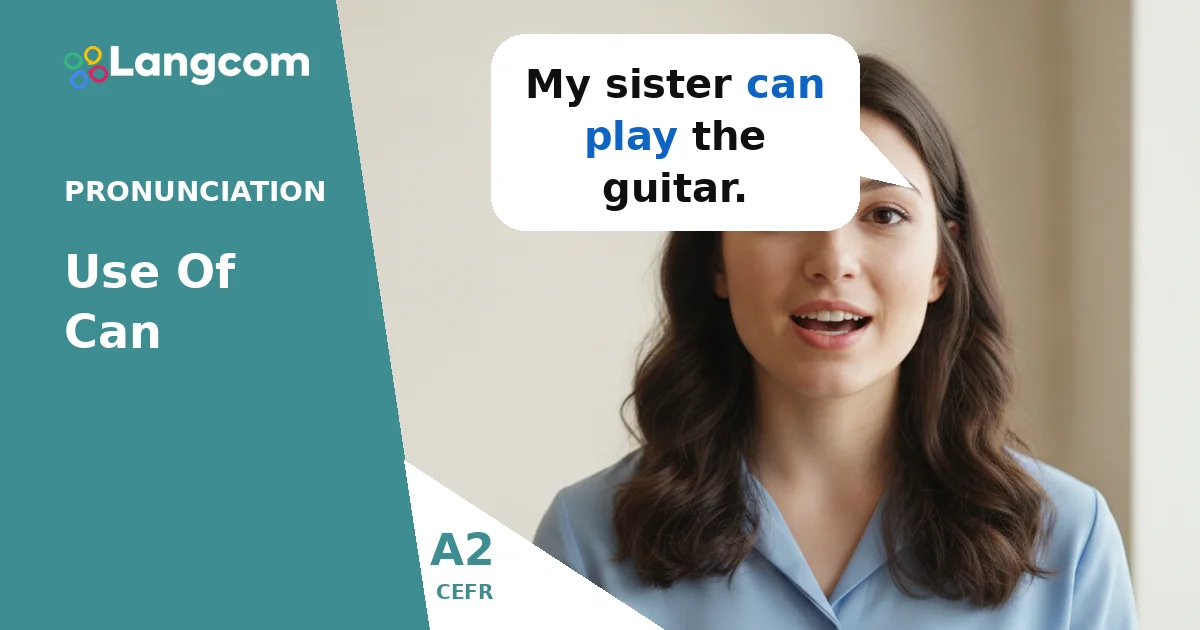
- My sister can play the guitar. (weak /kən/)
- Can you hear that music? (weak /kən/)
- Yes, I can. (strong /kæn/)
- No, I can't. (strong /kɑːnt/)
- We can meet tomorrow. (weak /kən/)
- They can't come to the party. (strong /kɑːnt/)
التدريب
هل أنت مستعد للحصول على شهادتك؟
يُعد برنامج Langcom الطلاب لامتحانات كامبريدج وIELTS وTOEFL وDELE وSIELE وMichigan.
ابدأ مع Langcomالأخطاء الشائعة لدى المتحدثين باللغة الإسبانية
Mistake 1: Always using the strong form for can
Many Spanish speakers pronounce can as /kæn/ in all situations. This is incorrect and can make your English sound less natural.
- خطأ: I /kæn/ swim very well.
- الصحيح: I /kən/ swim very well.
Mistake 2: Not pronouncing the final /t/ في can't
Sometimes, the final /t/ sound in can't is not clear, especially before another consonant. This can make it sound like can, causing confusion.
- خطأ: I /kɑːn/ understand. (sounds like 'I can understand')
- الصحيح: I /kɑːnt/ understand. (the /t/ is important!)
الأسئلة الشائعة
Why is it important to learn the different pronunciations of 'can' and 'can't'?
Learning these different pronunciations helps you sound more natural and fluent. It also makes it easier for native speakers to understand you, especially when distinguishing between can و can't in fast speech.
How can I practice these sounds for the A2 Key exam?
For the A2 Key exam, especially in the Listening paper, you will hear these forms often. Practice by listening carefully to English speakers, paying attention to when can is weak (/kən/) and when can أو can't is strong (/kæn/ أو /kɑːnt/). Try to imitate what you hear.
Does the pronunciation of 'can' and 'can't' change in American English?
Yes, there are some differences. In American English, the strong form of can't is often pronounced /kænt/, with a shorter 'a' sound, similar to the strong can. However, the weak can (/kən/) and strong can (/kæn/) in short answers remain similar.

0 تعليق